Startup Blogs
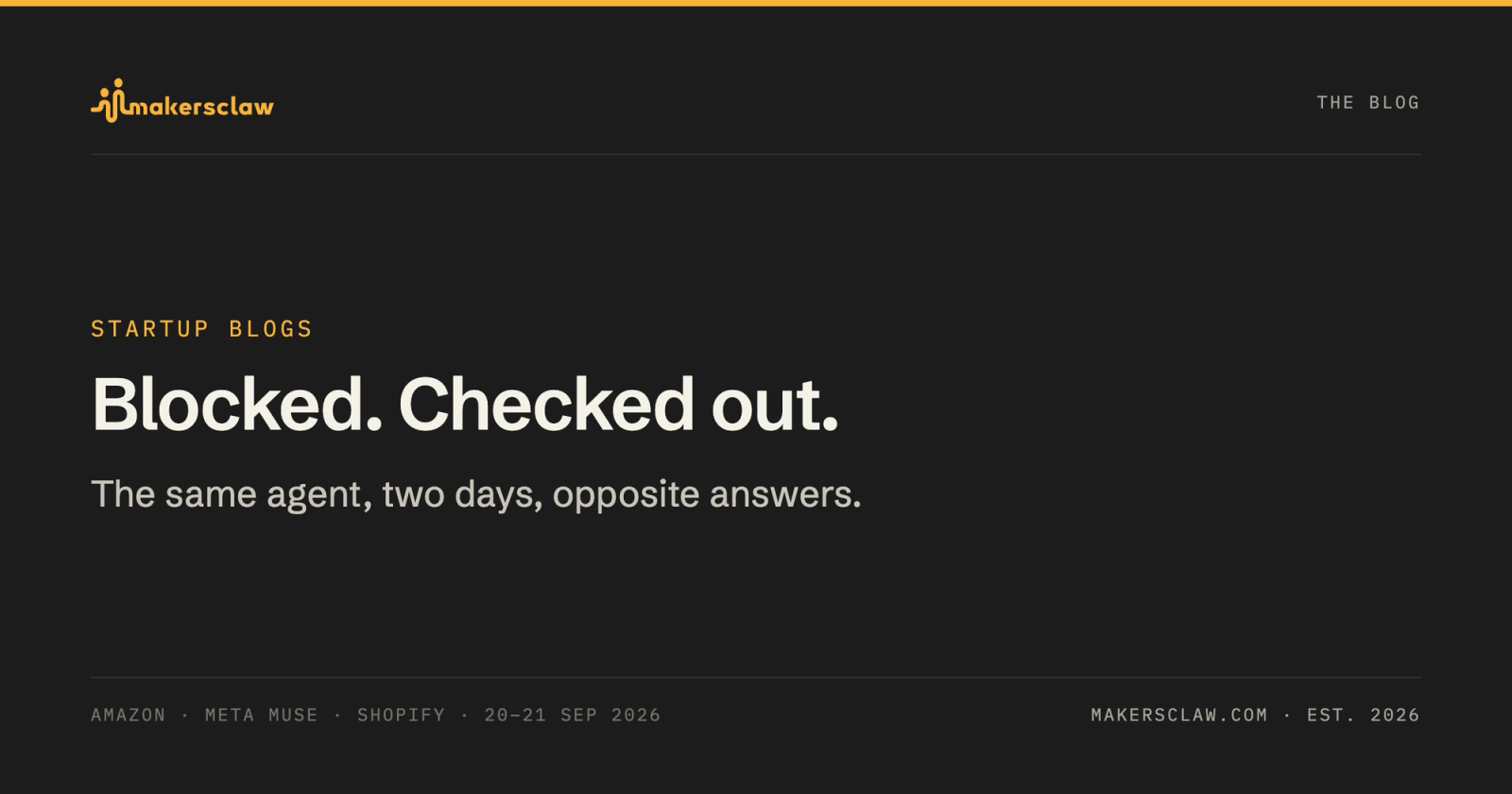
Amazon blocked the No. 1 free app in America from its store. Shopify gave it a checkout the next day.
Sunday night, Amazon told Meta's Muse agent that unauthorised agents violate its Conditions of Use. Monday, Shopify wired Shop Pay into Muse. Amazon made over $68 billion in ad revenue last year, a business that depends on browsing. Shopify's merchants need to be found.
As of Sunday night, 20 September, people asking Meta's Muse agent to buy something on Amazon got this popup: "Continued access by an unauthorized AI agent violates Amazon's Conditions of Use, to which our customers have agreed."
Muse was twelve days old. It had been downloaded 730,000 times in roughly its first five days, according to Sensor Tower, and the Friday before, it had passed ChatGPT as the top free iPhone app in the US. On Monday, Shopify announced that Muse could now check out through Shop Pay across Shopify's stores. Mark Zuckerberg's post: "Shoppers find more. Shops sell more. More partnerships like this coming soon."
Two companies, the same agent, two days, opposite answers. The reason they chose differently is the useful part for anyone whose product an agent might one day try to use.
Why Amazon said no
Amazon told GeekWire's Todd Bishop that Meta never told it Muse would access its store and that it never agreed. The agent does not identify itself when it browses, Amazon says, and it appears to capture and store customer credentials. It can reach account pages and order history if a customer asks it to. Meta has said Muse "has no visibility into people's passwords or payment methods" and keeps the credentials a user shares in secure storage.
The identification point follows from how Muse works, as Meta's launch materials describe it. If a service has a public API, Muse connects with credentials the user provides. If it has no API, the agent "can use the service through a browser the way you would." To Amazon's servers, a Muse session looks like the customer.
Amazon's spokesperson framed the ask as ordinary commerce: third-party applications that buy on a customer's behalf "should operate openly and respect service provider decisions about whether or not to participate." The comparison they reached for was food delivery apps and restaurants, travel agencies and airlines: intermediaries that work with the businesses they transact with.
Then there is the number GeekWire put next to it. Amazon made more than $68 billion in advertising revenue last year, and that business depends on people browsing Amazon's pages and seeing sponsored products. An agent that goes straight to the item and checks out skips the pages the ads are sold on.
Amazon has been here before, and lost the first round
This is not a new position. Over the past year Amazon sued Perplexity over its Comet browser and moved to block shopping agents from Google and OpenAI.
The Perplexity case matters here because of how it went. Amazon won a preliminary injunction in March. On 4 August the Ninth Circuit vacated it, holding that under the federal anti-hacking law the user, not the AI company, is the one accessing Amazon's computers. The court denied Amazon's petition for rehearing on 10 September.
Read the Muse popup again with that in mind. It does not accuse anyone of hacking. It cites the Conditions of Use, "to which our customers have agreed." That is the avenue GeekWire notes the ruling left open: contract and terms of service, aimed at the customer's agreement rather than the agent's access.
Amazon also has its own agent, which is the other half of its argument. Its Buy for Me feature fetches items from outside brands' sites, and Amazon points out that Buy for Me identifies itself and lets brands opt out. The standard it is asking Meta to meet is the one it says it applies to itself.
It is also a fight between partners. Amazon products have been buyable inside Facebook and Instagram since 2023, and in April Meta signed a multibillion-dollar deal to run agentic AI workloads on Amazon's Graviton chips. Amazon says it is in direct conversation with Meta. Asked about legal action, it declined to comment.
Why Shopify said yes
Shopify's merchants do not own the demand. They are found. For a Shopify store, an agent that shows up with a buyer and a card is a customer, and the worst outcome is being the store the agent cannot finish checking out at.
So Shopify did not leave the checkout to chance. Muse can now browse Shopify-powered stores and pay through Shop Pay, the one-tap checkout that already holds a shopper's payment and delivery details, which means the purchase itself runs on rails Shopify controls. Deutsche Bank's analysts read it as another AI platform choosing to work inside Shopify's commerce infrastructure. Shopify's shares rose about 7%.
What was not announced is worth saying out loud: no financial terms, no revenue split, no rollout timetable. The traffic's dollar value to merchants is unproven.
The browser is also where Muse is weakest. Claire Vo's hands-on review of Muse a few days earlier found the agent excellent at the off-browser jobs she tried (a family morning brief, a gentle sleep-training goal), and she praised its permission prompts and activity feed. In the browser it struggled to find the right New Balance 9060s and got stuck. A more specific job, IMAX tickets, went much better. Her verdict on the browser: "hit-or-miss." A Shopify store whose checkout rides inside the agent has at least made the last step one its platform controls.
Meta had already opened the front door on its side. The Muse Connector Platform, opened the week before, asks developers to submit a connector for review and appear in a directory, with Stripe Link for payments. Zuckerberg's pitch for it: "You bring the API — Muse brings the agent, the browser, and the context of what the person actually wants."
What needed to be true for each answer to be right
Amazon's refusal works if three things hold. Customers keep starting their shopping on Amazon rather than in an agent. The ads on its pages stay worth more than the orders an agent would bring. And the terms-of-service route holds up where the anti-hacking route did not. None of those is proven yet, and the second one is the bet the whole position rests on.
Shopify's yes works if agents become a real share of buying and if Shop Pay stays the default rail inside them. The risk runs the other way: if Meta later builds its own checkout, Shopify will have helped build a shopping habit inside an agent it does not control.
For everyone smaller, the choice is simpler, because the $68 billion reason to refuse does not apply. A store that nobody starts at has no page views to protect.
What to take from it
Three concrete moves come out of these two days, and they apply whether or not you sell physical goods.
Decide whether agents are customers, and write it down. Amazon's popup rests on its terms of service, not on the anti-hacking law it lost on against Perplexity. If you want agents in, say so and say how. If you want them out, that is where Amazon is writing it.
Give the agent a named door. Muse's connector platform and Amazon's own Buy for Me point the same way: an agent that identifies itself, or calls an API it was invited to use, is the version a store can agree to. Shopify went part of the way by putting its own checkout inside the agent. An agent driving your website as if it were the customer is the version that gets blocked, and in Claire Vo's testing the browser was the hit-or-miss part.
If you build agents, identify them. Amazon's standard is the one it says it meets itself. Being open is no promise of access: Amazon has also moved to block Google's and OpenAI's shopping agents. But an agent that says what it is gives a store something to negotiate with, and one that doesn't gives it only a reason to block.
Muse users could still buy on Amazon on Monday morning. They just had to go to Amazon to do it.