
Startup Blogs
Pocket FM made audio 80× cheaper. The number worth watching is retention: 44% to 76%.
Pocket FM's run rate went from $250 million to $500 million in a year, and 93% of its catalogue is now AI-powered. Everyone reads that as a cost story. The number the CEO credits the extra content with moving is retention, and the cost cut was only the input.
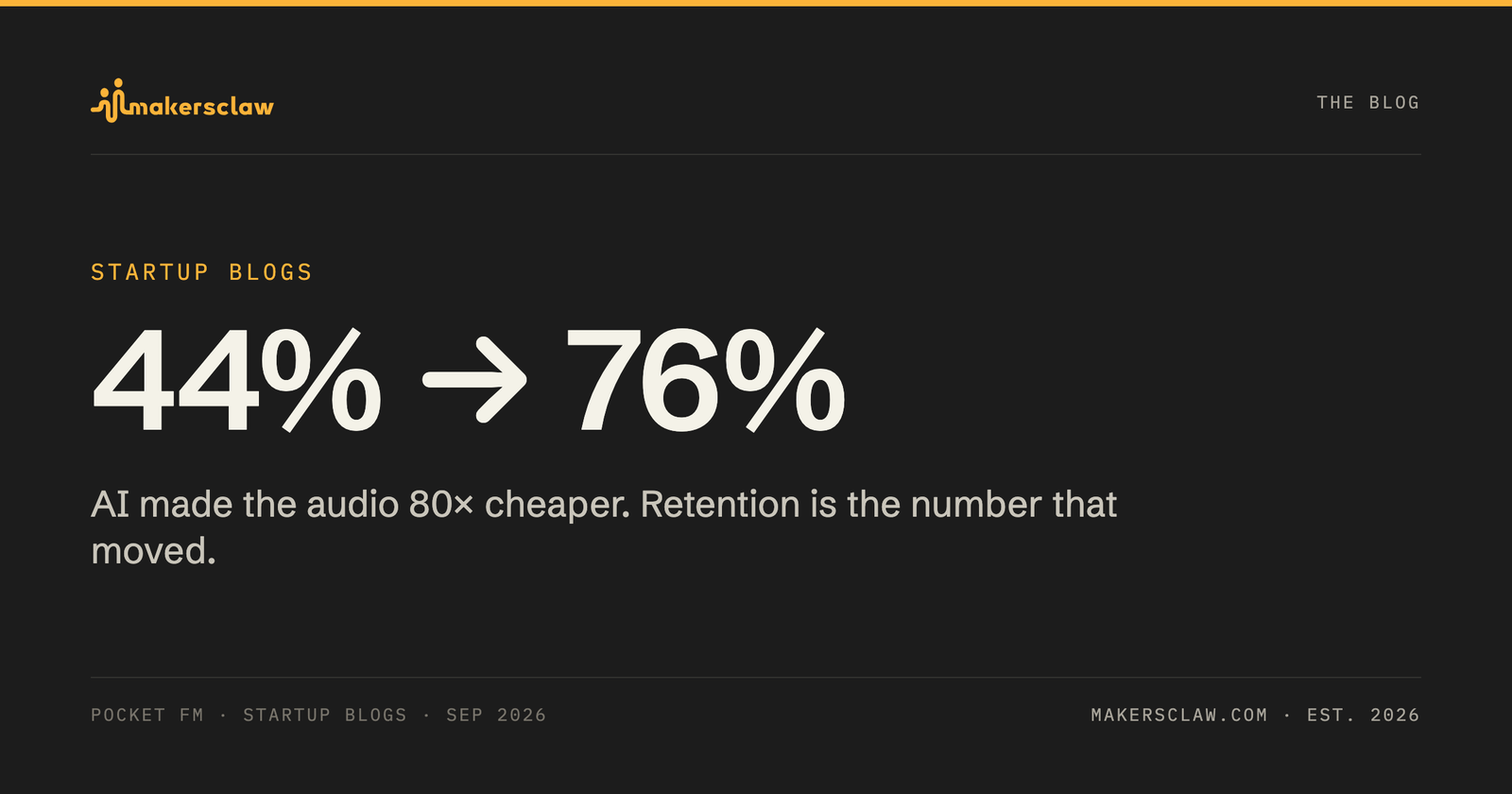
Two years ago Pocket FM's twelve-month revenue retention was 44%. Today it is 76%.
In an interview TechCrunch published on 10 September 2026, Pocket FM co-founder and CEO Rohan Nayak said the company had doubled its annualised revenue run rate to $500 million. The headline number was that AI now powers 93% of the catalogue. The production cost cut, about 80×, came next. Retention sat further down the piece. But when Nayak explains what all that extra content did for the business, retention is the number he reaches for.
The cheap-content figures are what travelled. They are real, and we will get to them. TechCrunch's own growth sentence names three drivers: more AI production, new markets (the UK, Germany and France among them) and user-generated content in the US. Our reading is that one number ties those together, and it is the one a builder can actually copy.
What happened, in the company's own numbers
Pocket FM is an Indian serialised-audio platform founded in 2018 and now run from Bengaluru and Culver City. Its stories run to hundreds of episodes. Listeners pay to unlock them one at a time.
The run rate, computed as monthly revenue times twelve, went from about $250 million a year ago to $430 million in April 2026 to $500 million now. About $415 million of that comes from users unlocking individual episodes. About $85 million is ads.
On the supply side, AI now produces 99% of new content and powers 93% of the catalogue. Production is about 80× cheaper than it was. A hundred hours of content that took roughly a year to make now takes a day. More than 550,000 creators are putting out about 2.5 million hours a year. Two years ago, Nayak says, the entire catalogue was about 100,000 hours. (TechCrunch's November 2024 piece put the catalogue at 200,000+ hours, and "two years ago" from September 2026 is roughly the same moment. The two figures are 2× apart and we cannot reconcile them. Either way, a year's output now exceeds the whole catalogue of two years ago by more than ten times.) The library now holds more than 770,000 series.
Humans still originate the stories. Nayak's line: "We want to create great IPs that last 100 years, and that needs humans." AI handles production and localisation, using models the company trained itself on years of listening data.
The mechanism is breadth, and retention is how you measure it
Here is how Nayak connects the two halves. More stories means more listener preferences get matched. A listener who would have churned because the platform had nothing in their sub-genre now finds something and keeps paying. In his account, that is part of what moved twelve-month revenue retention from 44% to 76%.
The chain runs like this: cost falls 80× → annual output outgrows the old catalogue many times over → the catalogue covers more tastes → retention rises → per-episode unlocks compound. The cost cut is the first link. Retention is the link that turns volume into revenue.
A competitor can buy text-to-speech off the shelf, as Pocket FM itself did with ElevenLabs in 2024, so the cost cut alone buys it nothing exclusive. Pocket FM spent the savings on breadth against a metric it was already watching. The metric moved.
If you are building anything with a catalogue, skip "how much cheaper can I make each unit." Ask "which retention number does breadth move, and am I measuring it."
The three-year arc, dated
This did not happen in one release. TechCrunch has covered the company three times. The numbers form a sequence.
November 2024. Ivan Mehta reports the catalogue at 200,000+ hours. An ElevenLabs partnership makes audio production 5× faster and 30× cheaper than professional recording. More than 40,000 series use AI voices and have earned $3 million between them. Financial-year 2024 revenue: $127 million. Nayak's own diagnosis at the time: "I still feel that our content catalog is not sufficient for our users. There are so many genres and subgenres that we don't have in our library." The breadth thesis was already stated. The writing and adaptation tools to act on it were still in testing.
August 2025. Mehta again. The company rolls a writing tool called CoPilot out to every writer. It handles beat analysis, narrative-to-dialogue conversion, cliffhanger suggestions, character bios and a review pass. Adaptation tools change names and idioms, not just language. Nayak says a new market used to take 12 to 18 months to reach the 1,000 hours of content needed to start acquiring users; with the tools it takes under three. Germany, where the tools were trialled, is the proof point: writer output there rises by up to 50%. AI-assisted series in the US reach 10% of playtime and $7 million in revenue over twelve months at 2 to 3× lower cost. The company launches close to 1,000 pilots a month.
September 2026. Jagmeet Singh's interview: 80× cheaper, 2.5 million hours a year, 76% retention, $500 million run rate.
Read in order, the cost multiple goes 30× → 2 to 3× on a harder task → 80× across the pipeline. The catalogue two years ago was somewhere between 100,000 and 200,000-odd hours, depending on which figure you take (see the note above); annual output is now 2.5 million hours. In 2024, Nayak named catalogue depth as the problem. In 2026, he credits the fix, in part, with the retention rise.
The hit maths
Pocket FM does not know which story will work. It says so. In the 2024 piece Nayak calls spotting blockbusters "a hard problem." The 2025 piece describes the approach plainly: about 1,000 pilots a month, and "the sheer volume of content results in a few of them becoming hits."
The 2026 numbers show what that volume produces. Out of 770,000+ series, 96 titles have earned more than $1 million each and 13 have crossed $10 million.
That is a portfolio strategy. It only works if the cost of a losing pilot is close to zero. At an 80× cost reduction, it is. At professional production cost, it was not. That is why the company could state the thesis in 2024 and only run it at scale once the writing tools landed in 2025.
The nearest thing to a control case: Pocket Saga
Pocket Entertainment, the parent, launched a microdrama video app called Pocket Saga three months before the interview. It is US-only. Its content is entirely AI-produced, with no live-action production. But it is not human-free at the root: successful Pocket FM audio stories, which humans originated, are turned into video for it.
It is at about $15 million annualised run rate.
This is the same playbook with the human production layer removed, and at least partly human-originated stories underneath. That makes it a partial test, not a clean one. TechCrunch does not say whether Saga carries any stories that did not start with a human on Pocket FM. Still, it is the one to watch: if Saga ever runs on stories no human originated and its retention holds up, the "humans originate" line looks like a preference. If it does not, Nayak was right about needing them.
The scars
TechCrunch's August 2025 reporting includes the parts missing from the run-rate announcement.
The company laid off employees and contractors across multiple rounds in the preceding twelve months. Writers reported diminished returns over time. Pocket FM was facing lawsuits in California over employment and wage issues. The company said it works with a project-based network of writers, voice artists and production partners. It also said that "AI has had minimal impact on our core creative community."
Distribution, per the 2025 piece, is flat: every show gets an equal initial push and listener engagement decides the rest. The quality question is open too. The company measures quality by a show's retention. TechCrunch names the risk: cheap production could fill the platform with low-quality content and bury the good shows. Pocket FM's answer is an AI moderation pass on every piece of content. It checks for duplication, copyright and "content health" before publication. A run-rate figure cannot tell you whether that is enough.
Two things to read carefully
"ARR" is a run rate. Nayak said explicitly that the $500 million is monthly revenue multiplied by twelve, not contracted recurring revenue. Per-episode unlocks are consumption, not subscription. Say "run rate."
Profitable on an adjusted basis. Pocket Entertainment, the parent, says it is profitable and generating positive cash flow on an adjusted basis. It declined to disclose profit, cash flow or margins. It is in talks to raise, with a reported $100 to $120 million at about $2 billion. Nayak did not deny the talks, declined to give a size or valuation, and says the company does not plan to list in the next 24 months.
What to take from it
"Use AI to make content cheaper" is table stakes now. What Pocket FM adds is an order of operations. It named the problem first. Catalogue depth was not matching listener taste, and the company said so in 2024. It then spent two years cutting the cost of a unit until a portfolio approach became affordable. The result was tracked against twelve-month revenue retention, a number a finance team would recognise, not an engagement proxy.
The cost cut paid for breadth, and retention is how they knew breadth was working.
If you are sitting on a cost cut from AI right now, the question worth an afternoon is: what would you build more of with it, and which number would tell you it worked?

