Startup Blogs
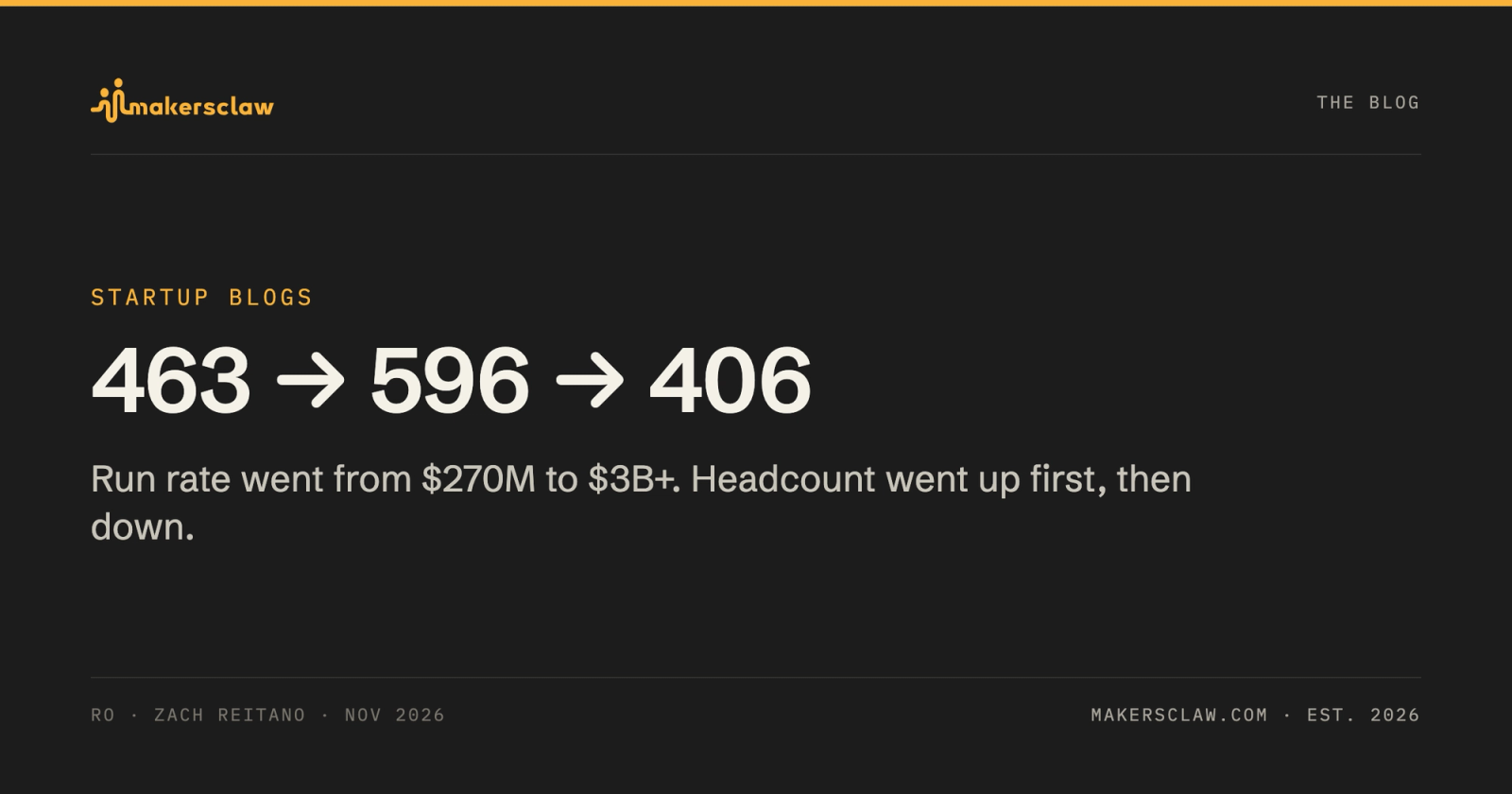
Ro had 463 people at a $270M run rate. It now has 406 at $3B+.
Zach Reitano now calls the Ro of December 2021 a zombie: 9% growth, a $270M run rate, 463 people. Two months later Ro raised $150M and promised to grow its B2B arm. By May it had 596 people. Then it cut 20% of staff, asked everyone left to opt in or out against a written menu, and shut its entire B2B arm. His figures, his moves, and the gate that stopped the hiring.
In December 2021, Ro had 463 people. It was growing about 9% a year at a $270M run rate, and it was burning cash.
By late 2026, it had 406 people (in October) and a $3B+ run rate.
Both sets of numbers come from Zach Reitano, Ro's co-founder and CEO, in an article he posted on X on 11 November. None are independently verified. Ro is private, and he defines the run rate himself: 12 times November revenue.
His word for the 2021 company was "zombie". "Not enough growth to matter, too much cash to die, and a pref stack that would squash an elephant." A pref stack is the pile of investor preferences that get paid back before anyone else in a sale. By his count, Ro had raised about $800 million over five years. Most of it was still in the bank.
The run rate grew more than ten times. The team shrank by 57 people. But the middle number is the one worth reading.
The number in between
Between those two dates, headcount went up first. By May 2022 Ro had 596 people, its peak.
So in the five months after those ugly 2021 results, Ro added about 130 people. That is our arithmetic from his figures.
Ro's own press release from that window shows why. On 15 February 2022, Ro announced it had raised another $150 million from existing investors. The same day it launched Ro Derm, a new skincare clinic. And it said: "this year, Ro will continue to expand its B2B offering." B2B here meant selling its in-home care and at-home testing to other healthcare companies.
That plan did not survive the year. Here is what Reitano says happened, in this order:
- January to May 2022: about 7 VPs left.
- June: about 20% of the company was let go.
- July: one of his co-founders "took a step back."
- August: Ro "refounded" itself. Everyone was asked to opt in or opt out.
- The next 90 days: about 6 to 8% of the company opted out.
He does not dress up the layoff. "It would have been a whole lot more efficient to never hire that many people in the first place."
The free takeaway: Ro changed its leadership first, then headcount, then asked everyone left to choose, against a written description of how the company works. The layoff set the size. The opt-in decided who stayed.
The menu
Reitano's diagnosis of 2021 was not mainly about cost. It was about who Ro had hired, and what it had told them.
In the early days, he writes, hiring ran on referrals. "Only 5 out of the first 100 people that joined Ro even applied on the website." Then Covid came, and Ro raised $500 million. Ro's March 2021 release calls that its Series D and puts total funding at $876 million. The pitch to new hires, he says, became "we're changing healthcare, come join." Nobody was told what the work was actually like.
His fix borrows from restaurants. A restaurant has a menu, so a vegan knows not to book the steakhouse. Ro wrote new principles and described each one twice: what it means and what it does not.
One principle is "Work Hard." Someone reviewing a draft asked if he meant "care deeply." He said no. That is a separate principle, called Big Heart. Work Hard means no fixed hours, and "you're going to work some nights and weekends."
At an all-hands, someone asked if Ro would ever try a four-day week. His answer: "No. And we'd sooner consider a 7-day work week." Then: "We're not going to consider a 7-day work week."
That sounds like a soundbite. It is the mechanism. The principles were built "to explicitly filter out people who we knew would not be happy here." A clear menu is what lets people opt out before the company has to push them.
He also splits feedback into two kinds:
- Bugs get fixed. Someone saying they lack the context to do their job is a bug.
- Features stay. Disliking leaders in the details, the lack of a 9-to-5, or the push on efficiency: those are features. People who want them changed "aren't going to be happy here."
Rehiring the people they wanted to keep
The opt-out handled people who did not fit. The founders also had to keep the ones they needed.
Right after the layoffs, Reitano and his co-founder Saman met the company's top performers at breakfast, lunch and dinner, every day for 30 days. In each meeting they did three things.
- Pitched the company again, as if hiring them fresh.
- Asked what they loved and hated about Ro.
- Gave them more equity and asked for 90 days. If nothing felt different after that, the founders would personally help them find their next job.
The 90-day offer has an exit built in. That is what makes the ask believable.
What got cut
The February release promised more B2B and planned one brand. The brand plan held. The B2B plan did not.
- Brands. Reitano lists seven: Roman, Rory, Modern Fertility, Ro Mind, Ro Derm, Workpath and Kit. Ro "needed one brand." The consumer brands folded into Ro. Workpath and Kit were also what Ro sold to other companies, and that B2B work went in the shutdown below. The February release had already planned "one Ro-branded platform" for 2022. This was the one plan that held.
- Products. More than 10 were shut down.
- Revenue. About $50M+ of direct-to-consumer revenue he calls "vanity revenue", meaning sales with "upside-down unit economics." Each sale lost money.
- All B2B, and all external API integrations. Ro was powering Amazon Care with its routing software, Siemens clinical trials and Prudential's at-home lab tests. Over 10,000 in-home visits a month. "We shut it down."
- His own time. He said no to almost every conference, podcast and panel. He told investors that asking for his team's time would be "directly reducing shareholder value."
Cutting $50M of revenue at a $270M run rate is roughly a fifth of the top line, by our arithmetic. He does not say how much of it was gone by when.
The gate that stopped it happening again
This is the part most teams can copy on Monday.
After the layoffs, Ro deleted every open role. From then on, new headcount needed a structured business-case form. The functional lead reviewed it. Then the CFO and the founders had to approve it. Automatic backfills stopped: someone leaving no longer meant a new job post. And Ro tracked net revenue per employee, for the whole company and for each function, over time.
Reitano's own one-line summary: "This is the system that works to prevent that from happening again."
The results, again in his figures: ARR per employee up more than ten times in four years, and people plus operating costs under 15% of net revenue. Run his endpoints and you get about $580,000 of run rate per head in December 2021. By late 2026 it is about $7.4 million. That is our division, not his number, and it inherits every caveat on his inputs.
Smaller tools he credits
- Sequential, not parallel. One big thing at a time, held "far longer than seems reasonable."
- The Tomorrow Wall. A place to park ideas, so people stop fighting to build them now.
- No long roadmaps. Priorities once a year, real precision only for 90 days, nothing longer.
- Steer Docs. Short course corrections between planning cycles, always in the same shape: background, route guidance, next steps, takeaways, FAQ.
- Leadership monthlies. A full day each month, with two hours on the previous month's financials.
- Daily Steers. After Ro Body, its GLP-1 weight-loss service, launched, the founders met that team every day at 8:50am for two years.
What to discount
Reitano tells readers to take the whole post "with a grain of salt." He means his sample size is one. There are two more reasons.
First, every number is his. The headcounts, run rates and ratios come from the CEO of a private company, in a post he wrote himself. His charts also say headcount is counted "as of Nov 1st each year," which sits a little awkwardly next to the December and May dates in his list. His funding total, about $800 million, is lower than the $876 million Ro announced in March 2021.
Second, the market helped. Ro is now, in his words, the leading provider of GLP-1s in the US. He answers the "you just rode a wave" line himself: "The wave was real. It was available to everyone, but there's only one leader."
He reads that as a win for execution. Our read is narrower: the revenue curve is partly the wave. The headcount line is not. A market can lift your sales. It cannot stop you hiring 130 people in five months.
That is the reusable part. Ro wrote down how it works, let people leave on that basis, and then made every new hire need a CFO's signature. The team went from 596 to 406 while the run rate grew more than tenfold. That part was a decision, not a market.