Startup Blogs
Stripe offered $1.2B for Airwallex when it made $2M a year. Jack Zhang said yes, then flew home.
In 2018, Stripe offered $1.2 billion for Airwallex, a Melbourne startup with about $2 million in revenue. Jack Zhang said yes, flew home, and changed his mind. What Stripe was trying to buy, what it cost Airwallex to keep it, and where the company stands now.
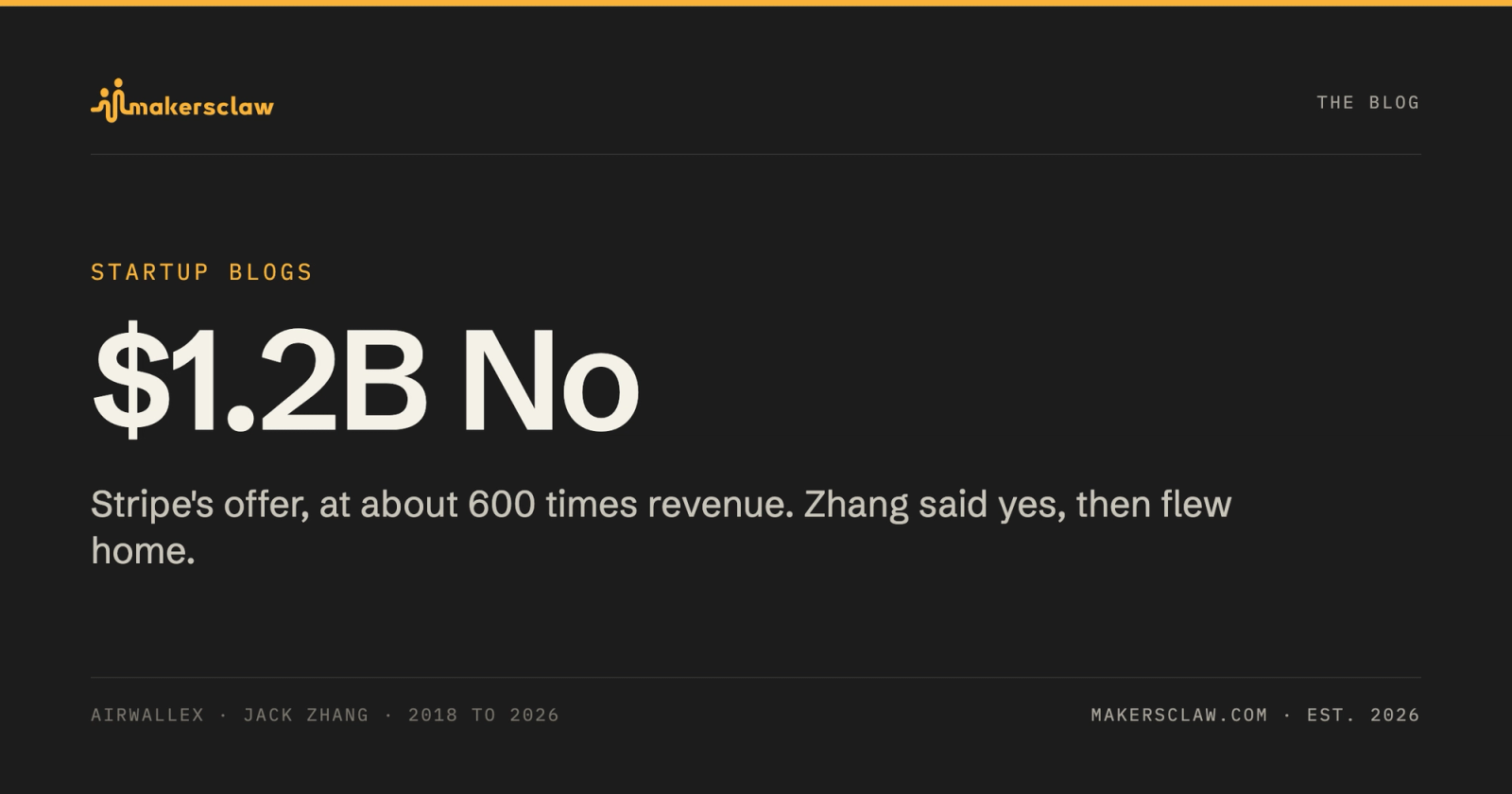
In 2018, Stripe offered to buy Airwallex for $1.2 billion.
Airwallex was three years old. "At that time, we only had $2 million revenue," co-founder and CEO Jack Zhang told CNBC Make It in February 2026.
That is about 600 times revenue. Zhang said yes. Then he changed his mind.
The two weeks in San Francisco
Zhang told the story to TechCrunch in April 2026.
He was 34. Michael Moritz of Sequoia, a Stripe backer whose China arm had invested in Airwallex, invited him to his home to make the case for selling. Patrick Collison was a generational founder, Moritz argued. The deal would compound.
Zhang walked around San Francisco for two weeks. At one point he said yes.
Then he flew back to Melbourne. "I was three and a half years into the business," he told TechCrunch. "The business was growing 100 times in 2018. And I only just sort of tasted what it [was like] to be an entrepreneur."
Two of his three co-founders had voted against the deal. Airwallex stayed independent.
In a LinkedIn post of December 2025, Zhang explained what worried him about selling. The deal came with a five-year lockup. "After Stripe deal, I'd be 39. But then what?" He did not know what he would build next. "And that scared me more."
What Stripe was actually buying
Zhang's post also explains why he thinks Stripe wanted Airwallex. His answer is the licences, not the revenue.
He splits fintech in two:
- Processing payments. A card is swiped and money goes from A to B. For that, he writes, you just need agreements with Visa and Mastercard.
- Holding money. Storing balances in many currencies and paying out. That needs a licence, such as an e-money licence, from each country's regulator. Sometimes, he writes, it takes three or four years per country.
In 2018, by his account, Stripe held e-money licences in two places, the US and the UK. Airwallex had licences in many more.
Airwallex started with the problem of holding money. Zhang ran a Melbourne coffee shop with his university friend and co-founder Max Li, CNBC reported. Paying overseas suppliers through the banks was slow and expensive. TechCrunch reported that Li watched payments to bean suppliers get frozen by US intermediary banks. Some bounced back weeks later. The founders set out to build their own way to move money between countries.
When a buyer offers 600 times your revenue, they are not paying for the revenue. Find out what they are paying for. For Stripe, by Zhang's reading, it was the licences. Those were the slowest thing in the company to build. They were also what Airwallex would be giving up.
What keeping it cost
Zhang calls his strategy the "path of max resistance". He told TechCrunch what that meant in practice.
- Licences, one country at a time. Airwallex now holds close to 90. Its own June 2026 release says 85 or more. The licence in Japan took seven years.
- Shell companies. In some emerging markets, central banks no longer issued the licence Airwallex needed. So it bought companies that still held one and rebuilt the technology underneath.
- Physical security. "You can't really vibe-code an integration with Mexico's central bank," he said. Getting into the room that holds it takes a biometric scan.
Growth was slow at first. "It took us six and a half years to get to $100 million in annual recurring revenue," Zhang told TechCrunch. "But after that, it took just over three years to get to a billion."
His own blog post of 3 November 2025 gives another measure of that growth. It took nine years to reach $500 million of annualised revenue. The second $500 million came in just over one year.
What the licences turned into
Holding money in many countries let Airwallex sell more than transfers.
In November 2025, Zhang gave Fortune the split of revenue:
- business accounts, like Mercury's: 34%
- payments: 30%
- spend management: 20%
He put gross margins above 60%. Airwallex also sells its network of licences to other fintechs, such as Brex, Rippling and Deel, Fortune reported. It now competes with Ramp, Stripe, Mercury, Brex and Revolut. "We're competing with too many people," he joked.
Some of the customers are rivals. In a July 2023 release, Brex co-founder Henrique Dubugras said Brex used Airwallex for local currency collections on its global card and for employee expense reimbursements abroad. "Brex has invested years and millions of dollars in the financial infrastructure to power this global money movement," he said, "and therefore chooses its partners very carefully."
For a rival that had already spent years building its own rails, plugging into Airwallex's licences was the faster way into new markets, by the release's account. That is the buyer's side of the licence argument.
Zhang is also clear about who it doesn't suit. "If you're a U.S. company, and you only have operations in Ohio, you better go with Ramp," he told Fortune. His customer wants to sell in Australia, Singapore, the UK and Canada at once. It wants banking, payments, spend and treasury in one place.
Where Airwallex stands in November 2026
Since then:
- December 2025: a $330 million Series G at an $8 billion valuation. Annualised revenue passed $1 billion in October 2025, up 90% on the year, per the company's release. San Francisco became a second headquarters, alongside Singapore.
- March 2026: annualised revenue of $1.3 billion, up 74% on the year.
- June 2026: a $320 million Series H at $11 billion, led by Addition, per the June release. That is about nine times Stripe's 2018 offer.
All of these are the company's own figures. Airwallex is private, and none of them is audited.
It is not public yet. Zhang told TechCrunch an IPO was at least three to five years away. In August, co-founder and president Lucy Liu told Fortune the company still aimed to be "IPO-ready" by the end of 2026, but "it's just not the best time".
Growth in the US has also brought political scrutiny. Senator Tom Cotton wrote to Treasury Secretary Scott Bessent in June about Airwallex's ties to China, Fortune reported. They include a reported 20% stake held by Tencent and HongShan, formerly Sequoia China. Zhang says Tencent's stake is passive, under 10%, with no board seat, and that US customer data stays in the US, out of reach of staff in China. In September, John Moolenaar, chairman of the House select committee on China, wrote to Bessent too, the AFR reported. Zhang calls it an increasingly conspiratorial political campaign. The fight is over who owns Airwallex and who can see its data.
Stripe and Airwallex now compete. Zhang told TechCrunch that he and Collison were both at a Greenoaks gathering in 2025. They didn't speak.
What to take from it
The lesson is not "turn down the big offer". Most founders should take it. Zhang nearly did.
What is useful is the question he asked first.
- Ask what the buyer lacks. Stripe could already process payments. By Zhang's account, it could hold money in two countries.
- Price the thing that is slow to build. Revenue says little about a licence that can take three or four years per country. Its price is what a buyer would pay to skip those years.
- Check whether you still want the work. Zhang's other reason was a five-year lockup and no next idea. That part isn't in any model.
- Know the bill. Keeping the company meant six and a half years to $100 million, shell companies, biometric scans, and now US politics.
In 2018, Stripe offered $1.2 billion for a company with about $2 million of revenue. In June 2026, investors valued Airwallex at $11 billion.