Startup Blogs
Intercom priced its AI agent at $0.99 a resolution. Its CEO says the switch killed about $60M of ARR.
In May 2023, Intercom charged $1.90 each time its new AI agent, Fin, resolved a customer question. By the end of June the price was $0.99, sold next to a helpdesk still priced by the seat. Eoghan McCabe says moving customers onto that model killed about $60M of ARR. What his own numbers show, and how Zendesk''s new plan, at the same $0.99, goes further.
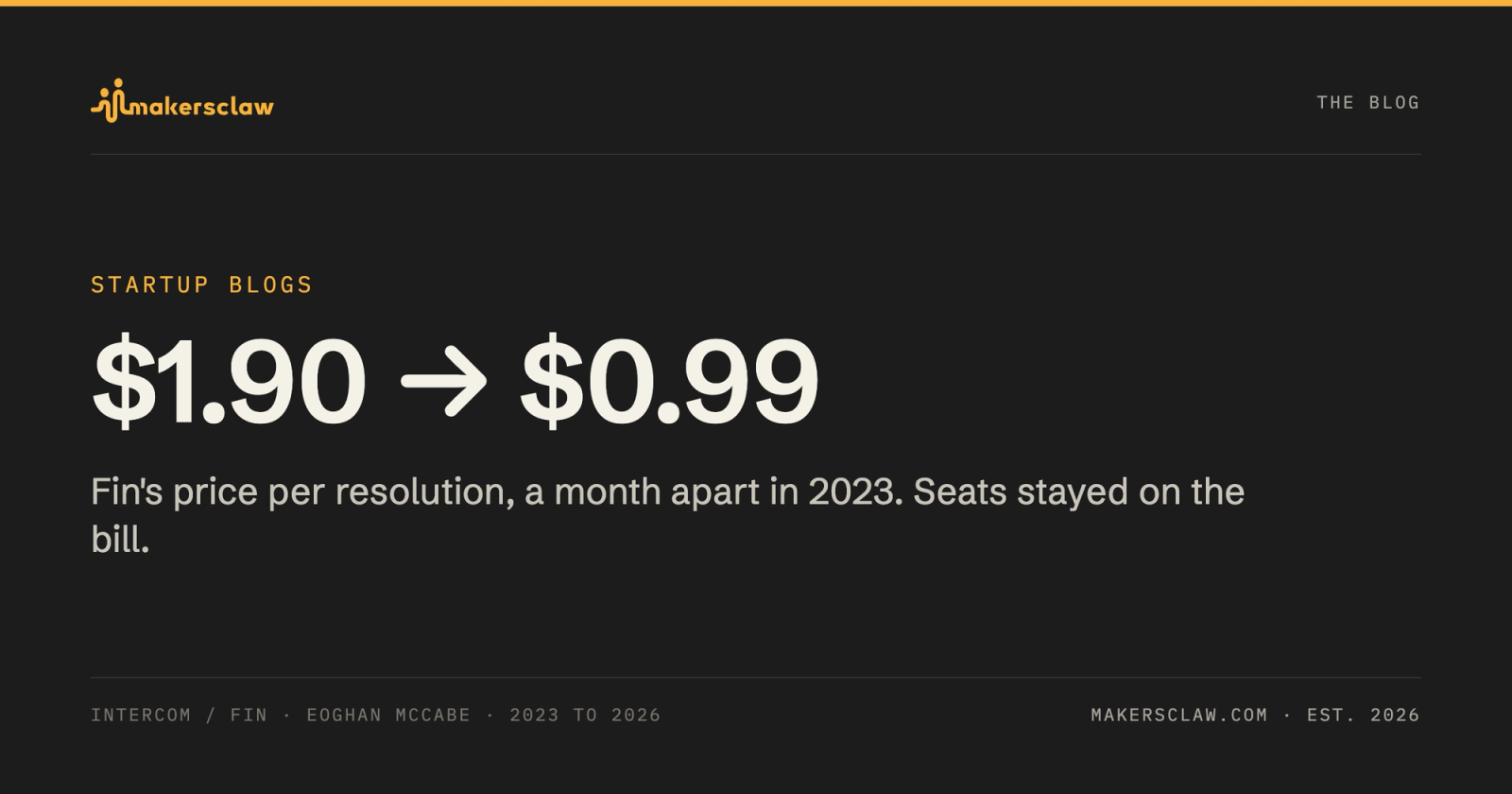
In May 2023, Intercom charged $1.90 every time its new AI agent, Fin, answered a customer and the customer needed no more help.
Intercom's own help page gave that price and said Fin was "priced at cost".
By 30 June 2023, the same page said $0.99. Both versions survive in the Internet Archive, a month apart.
That 99 cents is still Fin's headline price. It left Intercom selling a helpdesk charged per seat alongside an agent that might shrink the number of seats a customer needed.
Where Intercom was when it picked the price
Eoghan McCabe co-founded Intercom in Dublin in 2011. He stepped away as CEO, then came back in late 2022.
He describes his return in a LinkedIn article of 2 March 2026. He had been off "a two year hiatus while sick". The company was "heading quickly towards negative growth". A month after he returned, ChatGPT came out.
In an earlier post, of 11 June 2025, he puts a number to the decline. When he came back, Intercom "had just booked a 5th sequential quarter of declining NNARR". NNARR is net new annual recurring revenue: how much yearly revenue the company adds in a quarter. Five quarters in a row, it had added less than the quarter before.
Intercom announced Fin on 14 March 2023. It ran on OpenAI's new GPT-4. The post said the team's "main constraints are cost and pricing".
Customers soon questioned the price. On Intercom's community forum in May 2023, they pushed back on $1.90. One said their offshore support team, at $12 an hour, cost about the same. An Intercom staffer replied that GPT-4 was the most accurate model and Fin was priced at cost.
By the end of June, the price had roughly halved.
The free takeaway: in 2023, Intercom charged for the result, not the attempt, and took the risk on itself. If Fin answered and the customer still wanted a human, Intercom got nothing. Each answer cost real money in model calls. In effect, Intercom was betting that Fin would get better fast.
What McCabe says it cost
The seat business did not go away. Today's pricing page still sells the helpdesk per seat: $29, $85 or $132 a month on annual billing, depending on the plan. Fin is charged on top.
McCabe's March 2026 article explains where Intercom gave up revenue.
Intercom moved its whole customer base onto "a new, risky pricing model". It charged for the helpdesk and the agent together, "while reducing pricing for everything else, killing ~$60M ARR in the process."
The cannibalisation was in those price cuts. Seats stayed on the bill, but Intercom cut the price of everything else and concentrated its charges on the helpdesk and the agent.
He describes how the rest of the company changed:
- R&D. Nearly 80% of it moved to Fin "while that business was still a single digit percent of our revenue".
- Targets. The company's goals were rewritten around Fin revenue.
- Brand. Fin got its own site, on a .ai domain he says cost $1M, and "100% of our paid traffic".
- People. The AI team grew from about 6 to about 60 in three years.
In the June 2025 post he adds a pricing detail. The old pricing, he writes, had been "toxic". After the reset, 12-month net revenue retention for new customers was 146%, against 112% before. Net revenue retention is how much a group of customers pays a year later, as a share of what it paid at the start.
What came back
These are McCabe's figures. Intercom was private, and none of them is audited.
- June 2025: Fin was "a strong 8 figure ARR business" that grew at an annualised 393% in the first quarter of Intercom's fiscal 2026. That quarter was the company's biggest ever for net new ARR.
- 2 March 2026: "We're now at $400M ARR overall, with Fin about to pass $100M." Fin was growing about 3.5 times a year. He expected it to be about half of revenue "early next year".
- 9 March 2026: In a post announcing $250M of debt from Hercules Capital, he put Fin at 8,000 customers and a 67% average resolution rate. Revenue was "approaching $100M".
So in March 2026, by his count, Fin was about a quarter of a $400M business. That is our arithmetic, from his two figures.
What the 99 cents bought also changed in March. On 12 March 2026, Intercom's Darragh Curran wrote that Fin would bill per "outcome" instead of per resolution. A resolution still counts. So does a handoff where Fin gathers the details and passes a case to a human, if the customer set it up that way. The price per outcome stayed at $0.99.
Anyone copying the model needs to account for that change. "We only charge when it works" covered more as the product did more.
Then the name, then the sale
On 12 May 2026, McCabe renamed the company Fin. Intercom stayed as the name of the helpdesk. He wrote that all 1,400 employees now worked for Fin.
On 15 June 2026, Salesforce agreed to buy Fin for about $3.6 billion. The release cited more than 30,000 customer companies and a 76% average resolution rate. It closed on 10 September. Fin is now part of Salesforce's AI Labs, with McCabe still CEO.
We found no Fin revenue figure from Salesforce since. The last public ARR figures are McCabe's, from March.
Fin's price, checked on 17 November 2026 on fin.ai and in Intercom's Fin for Sales FAQ:
- $0.99 per outcome: a resolution, a set-up handoff, a sales lead turned away, or a prospect sent to self-serve
- $9.99 per qualified sales lead
- $1.99 per voice outcome, through sales
- charged at most once per conversation
The incumbent that went further
On 11 November 2026, Zendesk opened early access to Zendesk Unlimited. Zendesk, like Intercom, has sold its helpdesk by the seat.
These plans drop the per-seat charge entirely. Customers pay from an "Outcome Budget". Zendesk counts a conversational outcome when an issue is resolved, whether by AI, by a person using AI, or by both. Those "start at $0.99".
The difference is what stays on the bill. Intercom kept seats for the people and charged per outcome for the agent. Zendesk, in early access, wants to stop counting people at all and bill for the outcome however it got done.
What to take from it
The useful part of Intercom's story is not "price on outcomes". It is the order in which the company paid for that decision.
- Price the new thing on the result, before the result is cheap. Fin started at $1.90 at cost and dropped to $0.99 within weeks. Intercom carried the cost of failed answers while models were expensive.
- Cut the old bill on purpose. By McCabe's account, about $60M of ARR went when Intercom lowered the price of everything but the helpdesk and the agent.
- Move the company before the revenue moves. Most of R&D went to Fin while it was a single-digit share of revenue.
- Expect the definition to drift. "Resolution" became "outcome" three years in.
In May 2023, Intercom's AI agent cost $1.90 a resolution. By the end of June it cost $0.99. In November 2026, Zendesk's new outcome plans start at the same $0.99.