YC Applications
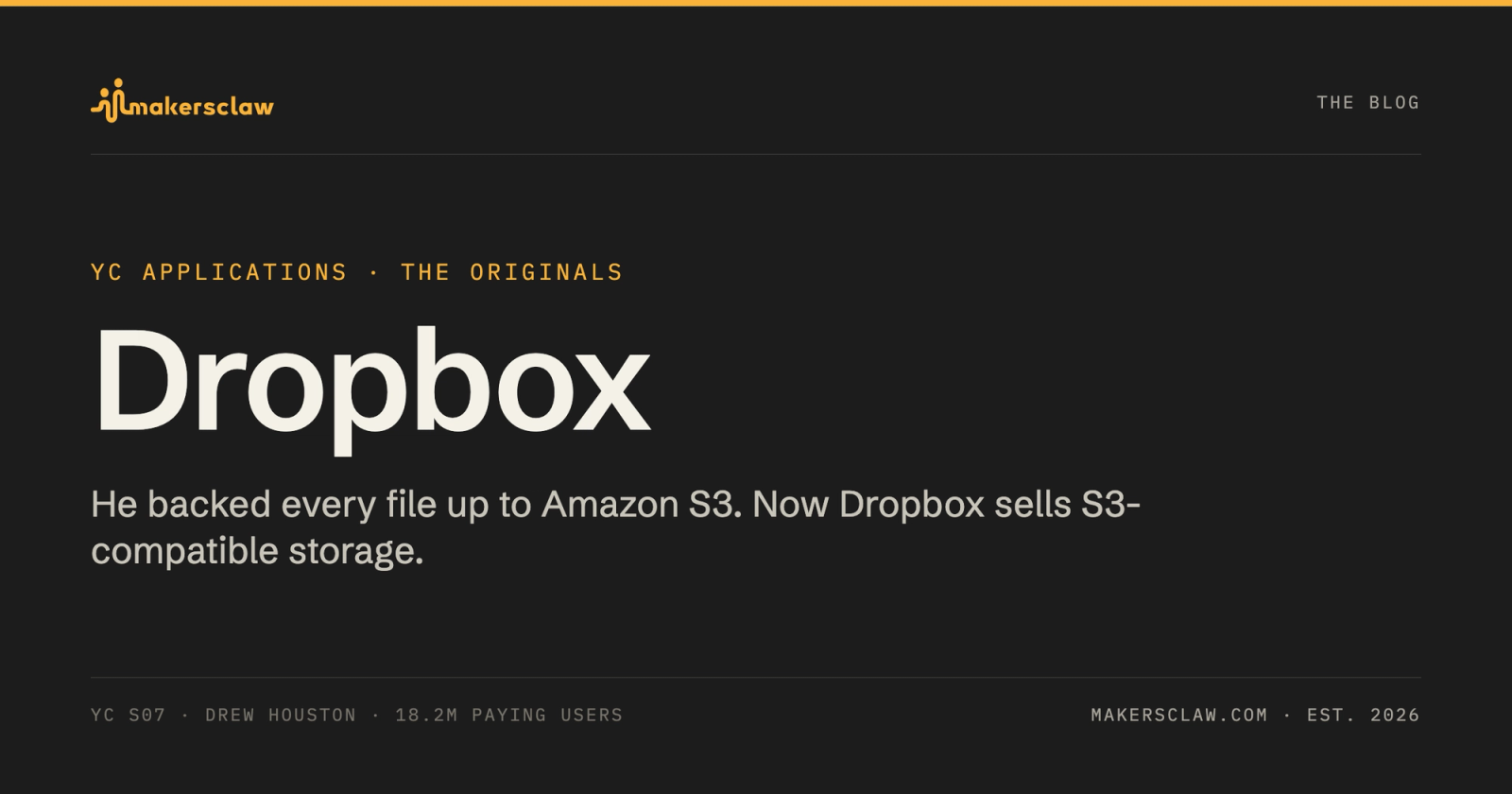
His YC application backed every file up to Amazon S3. Now Dropbox sells S3-compatible storage.
In 2007 Drew Houston pitched YC a Windows beta, about 7,000 lines of code, and files backed up to Amazon S3. Dropbox moved most data off S3 by 2016, went public in 2018, and in November 2026 began selling S3-compatible storage to AI companies. The form is below.
In 2007, Drew Houston applied to Y Combinator with a file-sync app and a screencast. He still had a job at Bit9, a security software company. He wrote that he was leaving "in a few weeks to work on this full time regardless of YC funding."
The pitch was one line: Dropbox "synchronizes files across your/your team's computers." It took tools programmers already used, like version control and rsync, and made them "just work" for everyone else. His test user was his little sister. She kept her high school term papers in it.
The progress was small. Three months of part-time work. About 5,000 lines of client code and 2,000 of server code. A Windows beta, with new "batches of people" let in every few days. No company yet: the incorporation answer is "No."
The storage was not his. Files were "securely backed up to Amazon S3," Amazon's cloud storage service. When he described an enterprise version that would sit on a customer's own network, he contrasted it with "my S3 store."
The form names one founder: Drew. Asked how long the founders had known each other, he wrote, "There's a joke in here somewhere."
On 4 April 2007 he posted the screencast to Hacker News as "My YC app: Dropbox - Throw away your USB drive." Houston has said Paul Graham then emailed him. Graham liked Dropbox, but YC would not fund a solo founder, and the deadline was three weeks away. A friend introduced him to Arash Ferdowsi, an MIT student. "After a grand total of 2 hours together," Houston wrote in 2020, they moved to California and Ferdowsi dropped out. YC lists Dropbox in its Summer 2007 batch.
The money plan was freemium: free 1GB accounts, "maybe ~$5/mo or less for 10GB," and team plans from "maybe $20/mo." The free plan is 2 GB today. The model held. Dropbox's 2025 annual report says more than 90% of revenue comes from self-serve, people who buy in the app or on the website.
Dropbox listed on Nasdaq in March 2018 at $21 a share. The prospectus counted more than 500 million registered users and over 11 million paying ones. Revenue in 2017 was $1.107 billion, with a net loss of $111.7 million.
The S3 line changed first. In March 2016, Dropbox engineer Akhil Gupta wrote that the company now stored over 90% of user data on its own custom-built hardware, a project called Magic Pocket. "We were an early adopter of Amazon S3," he wrote. The prospectus says the move finished in late 2016. The 2025 annual report still puts more than 90% of user data on Dropbox's own infrastructure, with Amazon Web Services holding the rest.
Then growth went flat. Revenue was $2.502 billion in 2023, $2.548 billion in 2024 and $2.521 billion in 2025. In the quarter to 30 September 2026, revenue was $637.3 million, up 0.5% on a year earlier. Paying users were 18.20 million, out of more than 700 million registered. The business is very profitable: a 27.5% operating margin under standard accounting, 42.2% on the company's adjusted measure.
The company got smaller. It cut about 16% of staff in April 2023, about 20% in October 2024, and about 9% in October 2026.
The founders moved on too. Ferdowsi left in 2020, after 13 years, Houston wrote. On 21 May 2026 the board named Ashraf Alkarmi, who ran the core Dropbox business, co-CEO. The plan is for Houston to become executive chairman after a transition. In the quarterly report filed on 6 November 2026, Houston is still listed as co-CEO. At the end of 2025 he held about 81% of the voting power.
On 5 November 2026, Dropbox announced DBX Agent Cloud, storage for companies building AI apps. It starts with "standalone, S3-compatible object storage," which works with tools built for Amazon S3. The same day it announced a deal to buy Tigris Data, an object storage startup, for about $350 million in cash, expected to close by the end of 2026.
The form got the user right: someone who hits Save and never thinks about sync. It also named the rival to fear: "Google's coming out with GDrive at some point." Google Drive launched in April 2012.
In 2007 Dropbox rented its storage from Amazon. In 2026 it is selling storage that works like Amazon's.
The application below is reproduced verbatim. Read it knowing what came next.
Dropbox: Y Combinator, Summer 2007 · Accepted Reproduced verbatim from the founder's application. Source: getintoyc.com
Company
If you have a demo, what's the url? Demo can be anything that shows us how the product works. Usually that's a video or screen recording.
Here's a screencast that I'll also put up on news.yc: getdropbox.com/screencast If you do have a Windows box or two, here's the latest build: getdropbox.com/u/2/DropboxInstaller.exe
What is your company going to make? Please describe your product and what it does or will do.
Dropbox synchronizes files across your/your team's computers. It's much better than uploading or email, because it's automatic, integrated into Windows, and fits into the way you already work. There's also a web interface, and the files are securely backed up to Amazon S3. Dropbox is kind of like taking the best elements of subversion, trac and rsync and making them "just work" for the average individual or team. Hackers have access to these tools, but normal people don't. It's currently in private beta and I add batches of people every few days.
There are lots of interesting possible features. One is syncing Google Docs/Spreadsheets (or other office web apps) to local .doc and .xls files for offline access, which would be strategically important as few web apps deal with the offline problem.
Founders
Please tell us about an interesting project, preferably outside of class or work, that two or more of you created together. Include urls if possible.
Accolade Online SAT prep (launched in 2004) (accoladeprep.com); a poker bot (here's an old screenshot: accoladeprep.com/sshot2.gif ; it's using play money there but worked with real money too.)
Please tell us in one or two sentences about something impressive that each founder has built or achieved.
Drew - Programming since age 5; startups since age 14; 1600 on SAT; started profitable online SAT prep company in college (accoladeprep.com). For fun last summer reverse engineered the software on a number of poker sites and wrote a real-money playing poker bot (it was about break-even; see screenshot url later in the app.)
How long have the founders known one another and how did you meet? Have any of the founders not met in person?
There's a joke in here somewhere.
If we fund you, which of the founders will commit to working exclusively (no school, no other jobs) on this project for the next year?
Drew
Do any founders have other commitments between X and Y inclusive?
No; I'm leaving Bit9 in a few weeks to work on this full time regardless of YC funding.
Do any founders have commitments in the future (e.g. finishing college, going to grad school), and if so what?
No. Probably moving to SF in September
Progress
How far along are you?
Prototype - done in Feb. Beta - in people's hands now. Version I can charge for: 6-8 weeks?
How long have each of you been working on this? How much of that has been full-time? Please explain.
3 months part time. About ~5KLOC client and ~2KLOC server of python, C++, Cheetah templates, installer scripts, etc.
Idea
What's new about what you're making? What substitutes do people resort to because it doesn't exist yet (or they don't know about it)?
Most small teams have a few basic needs: (1) team members need their important stuff in front of them wherever they are, (2) everyone needs to be working on the latest version of a given document (and ideally can track what's changed), (3) and team data needs to be protected from disaster. There are sync tools (e.g. beinsync, Foldershare), there are backup tools (Carbonite, Mozy), and there are web uploading/publishing tools (box.net, etc.), but there's no good integrated solution.
Dropbox solves all these needs, and doesn't need configuration or babysitting. Put another way, it takes concepts that are proven winners from the dev community (version control, changelogs/trac, rsync, etc.) and puts them in a package that my little sister can figure out (she uses Dropbox to keep track of her high school term papers, and doesn't need to burn CDs or carry USB sticks anymore.)
At a higher level, online storage and local disks are big and cheap. But the internet links in between have been and will continue to be slow in comparison. In "the future", you won't have to move your data around manually. The concept that I'm most excited about is that the core technology in Dropbox -- continuous efficient sync with compression and binary diffs -- is what will get us there.
Who are your competitors, and who might become competitors? Who do you fear most?
Carbonite and Mozy do a good job with hassle-free backup, and a move into sync would make sense. Sharpcast (venture funded) announced a similar app called Hummingbird, but according to Jeff (who is good friends with the tech lead) they're taking an extraordinarily difficult approach involving NT kernel drivers. Google's coming out with GDrive at some point. Microsoft's Groove does sync and is part of Office 2007, but is very heavyweight and doesn't include any of the web stuff or backup. There are apps like Omnidrive and Titanize but the implementations are buggy or have bad UIs.
What do you understand about your business that other companies in it just don't get?
Competing products work at the wrong layer of abstraction and/or force the user to constantly think and do things. The "online disk drive" abstraction sucks, because you can't work offline and the OS support is extremely brittle. Anything that depends on manual emailing/uploading (i.e. anything web-based) is a non-starter, because it's basically doing version control in your head. But virtually all competing services involve one or the other.
With Dropbox, you hit "Save", as you normally would, and everything just works, even with large files (and binary diffs ensure that only the changed portions go over the wire).
How do or will you make money? How much could you make?
The current plan is a freemium approach, where we give away free 1GB accounts and charge for additional storage (maybe ~$5/mo or less for 10GB for individuals and team plans that start at maybe $20/mo.). It's hard to get consumers to pay for things, but fortunately small/medium businesses already pay for solutions that are subsets of what Dropbox does and are harder to use. There will be tiered pricing for business accounts (upper tiers will retain more older versions of documents, have branded extranets for secure file sharing with clients/partners, etc., and an 'enterprise' plan that features, well, a really high price.)
I've already been approached by potential partners/customers asking for a web services API to programmatically create Dropboxes (e.g. to handle file sharing for Assembla.com, a web site for managing global dev teams). There's a natural synergy between project mgmt/groupware web apps (which do to-do lists, calendaring, etc. well but not files) and Dropbox for file sharing. I've also had requests for an enterprise version that would sit on a company's network (as opposed to my S3 store) for which I could probably charge a lot.
Equity
Have you incorporated, or formed any legal entity (like an LLC) yet?
No
Legal
Are any of the founders covered by noncompetes or intellectual property agreements that overlap with your project? If so, please explain.
Drew: Some work was done at the Bit9 office; I consulted an attorney and have a signed letter indicating Bit9 has no stake/ownership of any kind in Dropbox
Who writes code, or does other technical work on your product? Was any of it done by a non-founder? Please explain.
No
Others
If you had any other ideas you considered applying with, please list them. One may be something we've been waiting for. Often when we fund people it's to do something they list here and not in the main application.
One click screen sharing (already done pretty well by Glance); a wiki with version-controlled drawing canvases that let you draw diagrams or mock up UIs (Thinkature is kind of related, but this is more text with canvases interspersed than a shared whiteboard) to help teams get on the same page and spec things out better (we use Visio and Powerpoint at Bit9, which suck for working collaboratively); some ideas surrounding better web analytics for newbies
Please tell us something surprising or amusing that one of you has discovered.
The ridiculous things people name their documents to do versioning, like "proposal v2 good revised NEW 11-15-06.doc", continue to crack me up.
Keep reading
The rest of this article: His YC application backed every file up to Amazon S3. Now Dropbox sells S3-compatible storage.
The remaining sections are behind this point.
It costs an email address. The same address goes on Makersfuel, the MakersClaw briefing that runs Tuesday to Saturday, and every issue carries an unsubscribe link.
The address is used for the newsletter and nothing else. Privacy.