YC Applications
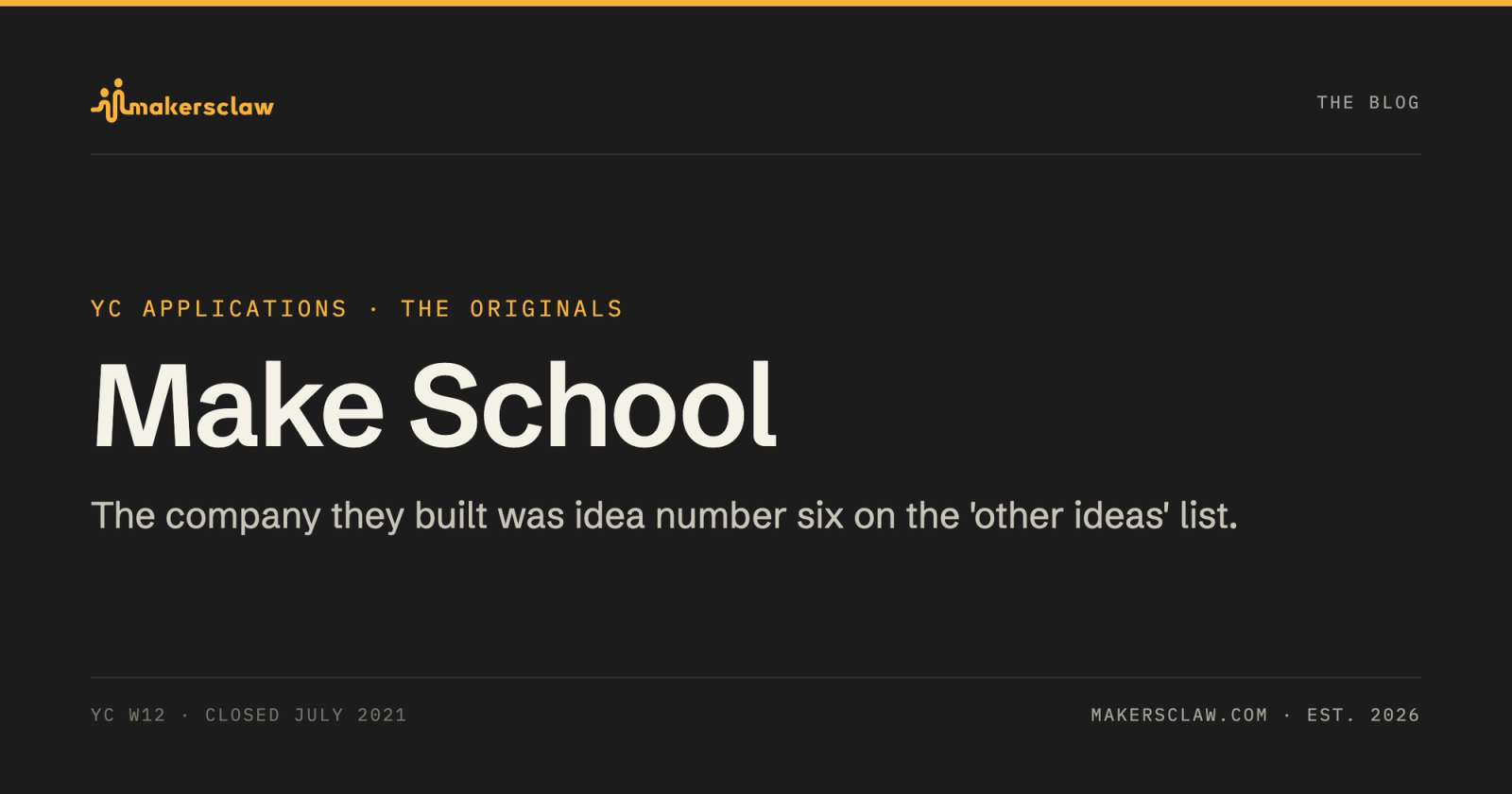
They applied to YC as a game publisher. The thing they actually built was idea number six on the 'other ideas' list, and it became a college.
MakeGamesWithUs got into YC W12 to match coders with artists and publish their games. The 'other ideas' answer lists an app academy for high-school developers as #6. That became Make School: a $15M Series B, an accredited degree, $10M a year, and a July 2021 shutdown. The form is below.
Ashu Desai and Jeremy Rossmann applied to Y Combinator in the fall of 2011. They had met in a computer science class at Menlo School in 2007, then dropped out of UCLA and MIT to make iPhone games together. Desai's first game, Helicopter, had sold 50,000 copies at 99 cents when he was 16. Rossmann's studio had shipped WarSquared, which Apple featured.
Their application describes a marketplace. Engineers who can code but cannot draw find artists. The site handles the contract and revenue split, while MakeGamesWithUs publishes the result and takes a cut. The founders even wrote out the revenue model: 30% of sales on 300 apps averaging $5,000 each, $450,000 in the first two years. The competitor they feared most was Appcelerator's Open Mobile Marketplace.
None of that is what they built.
The last section of a YC application asks for other ideas the founders considered. It notes that the partners often fund one of those instead. Desai and Rossmann listed six. Number six reads: "an app academy, open only to developers in high school in college," where students build simple games, the company pays artists to skin them, and publishes them for 99 cents or $1.99 at a 50% split.
The first classes ran for two months in the summer of 2012. They were held in a Palo Alto house for high-school students. By 2014, the company had renamed itself Make School and dropped the games. In 2015, it opened a two-year alternative to college paid for through income-share agreements: no tuition up front, a share of salary afterwards.
The state of California did not agree that it was a school. In 2016, the Bureau for Private Postsecondary Education said Make School was operating without approval and fined it $100,000. The fine was cut to $25,000 in July 2018 after the company received approval as a non-accredited institution.
That same year, Dominican University of California took Make School in as an incubated program, an arrangement Dominican's accreditor allows for new schools that are not yet accredited on their own. In December 2018, the accreditor approved a Bachelor of Science in Applied Computer Science delivered by Make School under Dominican's umbrella. Enrollment was 110 students, up from 40 a year earlier. Tuition for the two-year degree was $70,000. Graduates repaid it as a percentage of income once they earned at least $60,000.
In April 2019, Make School raised a $15 million Series B led by Venrock. It had reportedly raised an $8.2 million Series A the year before. Learn Capital, Kapor Capital, Tim Draper and Alexis Ohanian were on the cap table, along with YC. Desai's own retrospective puts the business at $10 million in annual revenue at its peak, and says the college had enrolled more than 300 students.
Then the company came apart over four weeks in July 2021. On 1 July, a lawsuit filed on behalf of 55 former students from the 2016–2018 cohorts alleged that the income-share agreements had been misrepresented. Rossmann told Yahoo Finance that day that the for-profit entity was "in the process of shutting down" and had begun an insolvency proceeding.
On 12 July, the accreditor declined Make School's application to stand on its own and invited it to reapply the following year. According to Dominican, the company said it could not afford to last that long. On 16 July, Dominican announced that it would take over the program directly. It did so on 30 July, with 150 students enrolled. Dominican's president called it "not the outcome Dominican and Make School anticipated." The program still runs today at Dominican in San Rafael.
The application is worth reading with that ending in mind, and not because the founders missed. Look at the question about what others in the industry do not get. Their answer is that there are "throngs of talented people capable and willing to create high quality games but are intimidated by the process." They saw their job as finding a way to "uncover latent talent who currently have no clear route to success." Swap games for careers and you have the mission Make School followed for nine years. The product changed completely. The belief underneath it never did.
Two other details look different in hindsight. The revenue answer says that by not being selective they would "sooner or later have a blockbuster on our hands." The school they built was selective, and the financing that replaced the blockbuster is what the 2021 lawsuit was about. The 50% revenue share on student games also looks like a first draft of an income-share agreement: pay nothing now, give up a slice of what you earn later.
The application below is exactly what they filed. Read it knowing how it ends.
MakeGamesWithUs (later Make School) — Y Combinator, Winter 2012 · Accepted Reproduced verbatim from the founders' application. Source: getintoyc.com
Company
What is your company going to make? Please describe your product and what it does or will do.
1\. We will build a matchmaking website that allows engineers and artists to make mobile games together. We will automate contracts and revenue share eliminating the need for business and legal knowledge. We will provide teams formed on our site with a workspace similar to Elance's or Odesk's. 2\. We publish the games created through our site. Unlike traditional game publishers (Zynga, EA, Chillingo), we can grow our catalog quickly and inexpensively. Every additional game we publish costs us less and less to promote as the strength of our cross promotional network grows. Our value proposition to engineers: we help you find an artist, promote your game better than you ever could, and you worry about nothing but code. Our value proposition to artists: we help you find projects to work on, give you finished projects to put on your portfolio, and help you share revenue with engineers you work with.
Founders
Please tell us about an interesting project, preferably outside of class or work, that two or more of you created together. Include urls if possible.
Ashu and Jeremy work together at Manifold Studios. We develop iOS games (www.manifoldstudios.com). Our first game, WarSquared, was featured on the App Store, and we are currently taking time off from school to work on another game, Realms at War, that we are launching by Christmas.
Please tell us in one or two sentences about something impressive that each founder has built or achieved.
Ashu: \- At 16, developed an iPhone game, Helicopter (downloaded 50k times at 99c). \- At 18, founded first company, DesaiData, and developed a fully functional prototype bluetooth gamepad for iOS devices.
Jeremy: \- At 18 founded Manifold Studios, recruited a team, raised money, and directed team towards launch of WarSquared which has been featured on the App Store. \- At 19, dropped out of school (along with Ashu) to work on new game Realms at War and hired 3 full time team members.
Please tell us about the time you most successfully hacked some (non-computer) system to your advantage.
My iPhone's lock button was broken, so the screen would never turn off and the resulting poor battery life made the phone useless. I wrote a simple app that activated the proximity sensor, so when I slipped the phone in my pocket the screen went black. This software fix to a hardware problem restored the phone's battery life and saved me $600.
How long have the founders known one another and how did you meet? Have any of the founders not met in person?
Jeremy and Ashu went to Menlo High School and took advanced classes in Math and Computer Science together in which we made our first (non-commercial) video games. We are currently living and working together at Manifold Studios
Progress
How long have each of you been working on this? How much of that has been full-time? Please explain.
As of October 2011, we have: -Begun contacting solo developers of promising but ugly existing apps on the app store. -Begun contacting artists willing to work with these developers for free and share revenue. -Begun development of a very simple game that we will publish with and without high-quality graphics, so we can accurately measure the impact of production value on sales.
By December, without needing to build to full site, we will have tested the essence of our site: matching talented engineers with talented artists, publishing the results, and taking a share of the revenue.
Idea
Why did you pick this idea to work on? Do you have domain expertise in this area? How do you know people need what you're making?
Ashu’s experience with Helicopter and Jeremy’s experience with Manifold Studios have given us a good understanding of the mobile games market and how to create the kinds of apps that get featured and make money.
When Ashu was writing Helicopter, he had limited knowledge of the art + business aspects of game development. With the right connections he could have produced a more professional app and improved sales. We hope to provide the right connections for people like 16 year old Ashu.
In the competitive market of mobile games, the little things (production values, targeted marketing, etc) can often make or break games. By reducing the friction involved in game development, we can allow more engineers to avoid obstacles on their way to making great apps.
What's new about what you're making? What substitutes do people resort to because it doesn't exist yet (or they don't know about it)?
We will grow our catalog of games faster and at a lower cost than anyone else in the industry. We don't claim to be able to separate the gems from the duds, but we can rely on metrics to provide merit-based promotion to promising games in our catalog and the gems will carry us to success.
Artist and engineers can find each other on freelancing sites, but to navigate a site like Elance one needs money and knowledge on how to write a contract. Additionally, few publishers will talk to small, independent first-time developers.
Thus, engineers resort to self-publishing lower quality games without great production value or effective means of promotion.
Who are your competitors, and who might become competitors? Who do you fear most?
Companies like Odesk, Elance, or 99designs are competitors, so are mobile game publishers (Zynga, EA). Incentivized install and ad networks such as Flurry and Tapjoy have raised developer funds which will compete with our service. Appcelerator’s Open Mobile Marketplace is who we fear most, they sell individual components and modules created by developers to be used in other apps.
What do you understand about your business that other companies in it just don't get?
While developing iOS games has a fairly low barrier to entry, there is a high barrier to success. As Ashu experienced himself, it was intimidating as a lone developer to spend money on art or marketing for Helicopter. Additionally, once you begin working in a team with 1,2,3 other people, legal issues and other complexities arise. We hope to reduce the friction involved in collaborative creation.
What others do not realize is that there are throngs of talented people capable and willing to create high quality games but are intimidated by the process. By creating a community of game creators who use us to meet other talented collaborators and publish games, we can in essence uncover latent talent who currently have no clear route to success
How do or will you make money? How much could you make?
We will make money by taking a portion of the revenue from the games we publish.
Every addition to our game catalog is created at no incremental cost to us. We use live metrics and machine learning algorithms to estimate the lifetime expected value of each game and adjust our promotional spending and crosspromotions accordingly.
Additionally, app sales are top heavy, so by not being selective and simply providing tools to facilitate high quality app development, we will sooner or later have a blockbuster on our hands.
In our first two years we are targeting 450k in revenue with a 30% revenue share on 300 apps that average $5000 in sales each. From there as we continue to grow our catalog the average sales of each app will increase as well.
How will you get users? If your idea is the type that faces a chicken-and-egg problem in the sense that it won't be attractive to users till it has a lot of users (e.g. a marketplace, a dating site, an ad network), how will you overcome that?
-Focus on generating success stories. -Heavily promote first games produced through our site. -Reach out to dozens of artists Manifold Studios has worked with, artist forums, and art students, pay them or give special perks to seed our site's community. -Reach out to friend network, Boston game developer community, contact solo developers of games on app store, pay them or give perks to seed our site's community. -Provide metrics drawn from apps we've published showing how publishing with us is really valuable. -Use existing games in Manifold Studios catalog to drive traffic to site.
Similar to how Craigslist began, we will first manually play matchmaker for our network of developers and artists. Once we begin to grow we will automate the process through our website.
Others
If you had any other ideas you considered applying with, please list them. One may be something we've been waiting for. Often when we fund people it's to do something they list here and not in the main application.
1\. Social games - we are developing a social game for iPhone called Realms at War. We hope to be the Kixeye or Kabam of mobile gaming – a more hardcore audience that is correspondingly more engaged and spends more. 2\. Games that teach people real world skills or solve real world problems. We could turn a website like Omegle into a game, allowing people to rate each others' conversation ability, and have everyone compete for the title of "Most Interesting Man/Woman in the World". 3\. Kickstarter, but for mobile apps. 4\. An App recommendation engine, through user profiling and collecting data from their social networks we could address the problem of discoverability in the app store. 5\. This or That engine. A user would input two products they wanted to buy (or two cities they wanted to visit), the system would profile you based on your Facebook and Twitter accounts and try to predict which of the two you would like more. Effectively this would be like asking your wife/girlfriend/mom for advice on what to do. 6\. The precursor to our main application idea: an app academy, open only to developers in high school in college. We provide guides, help, and a community, they develop (simple) games for free, we pay artists to skin them at no cost to the developer, and we publish the games for 99c or $1.99 taking 50% of the revenue.
Please tell us something surprising or amusing that one of you has discovered.
We recently found out that Trader Joe's sells the cheapest beer money can buy: Name Tag Lager. It turns out to be far more palatable than all the typical cheap college bears.