YC Applications
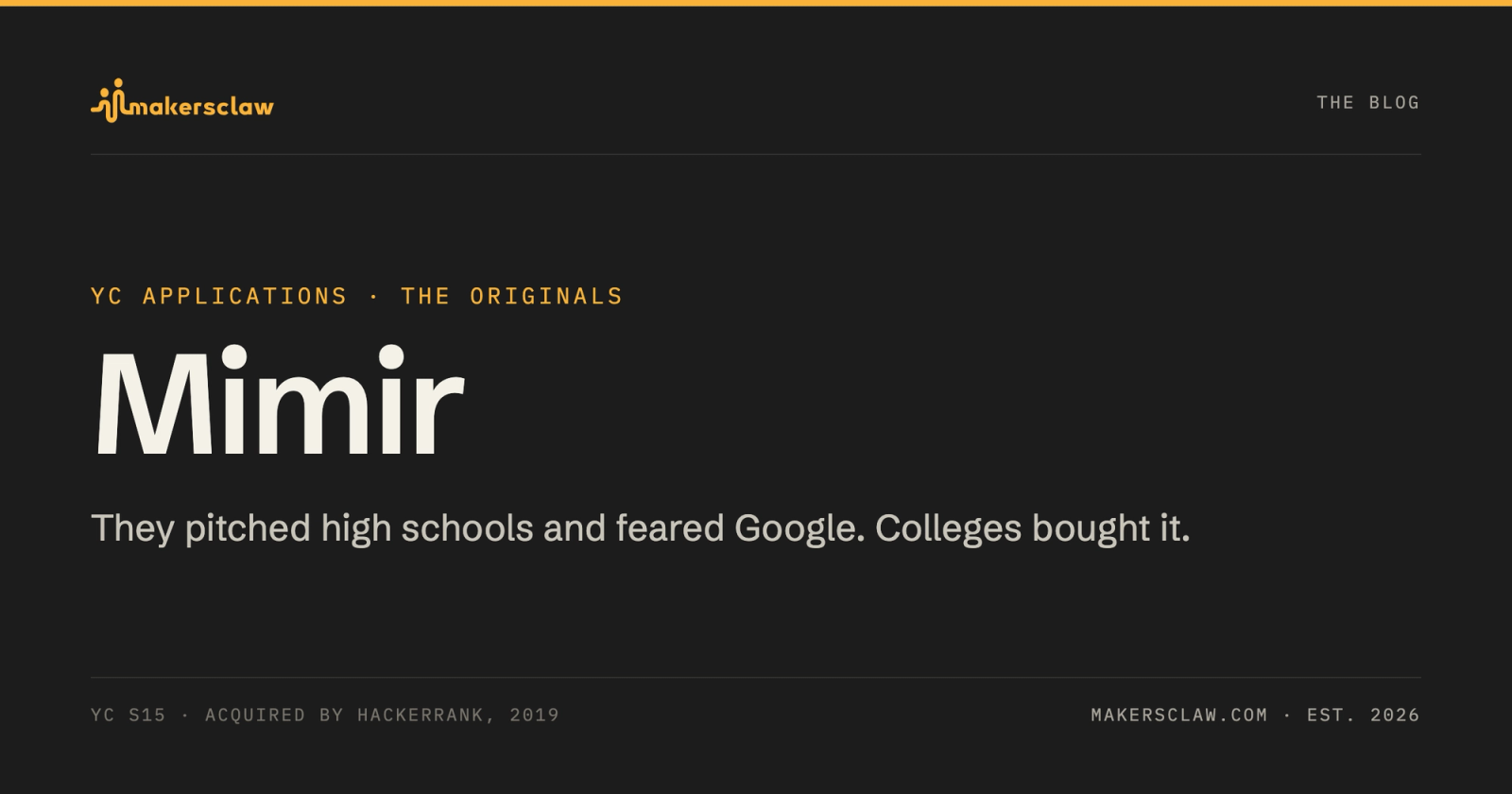
Their YC application hoped Google would buy them. HackerRank did, and Google was already using Mimir.
Three Purdue students applied to YC in 2015 to put automated CS courses into high schools. They feared Google and hoped it would buy them. Colleges bought the grader instead, HackerRank bought the company in 2019, and the product shut down in 2022. The form is below.
In spring 2015, three Purdue students applied to Y Combinator from West Lafayette, Indiana. Prahasith Veluvolu, Jacobi Petrucciani and Colton Voege had met in high school, where they ran a small app studio called In0v8. Their product was called Mimir Classroom.
Mimir would sell complete computer science courses to "any of the 80% of high schools in America that don’t offer any Computer Science courses." A school would need no CS teacher, just computers. Mimir would grade the work, catch plagiarism and give students a live chat with its own staff. They put the average deal at $35,000, half what they said a teacher costs. With what they called "around 80K" high schools lacking CS, that made "close to $3 Billion in America alone."
So far, they had 350 students, revenue redacted on the form, and about 100% growth over two academic terms. The form is also honest about the gap between the pitch and the live product, which "acts as a toolbox for existing courses rather than a standalone course."
The competitors answer is the one to remember. "By far, our biggest fear is Google," they wrote. Then: "We plan building Mimir to the point we become an acquisition target for them."
YC took them into Summer 2015. On 27 July 2015 the YC blog introduced Mimir as a tool for "university and college Computer Science programs": professors upload assignments and Mimir grades them. On 6 August Purdue's own release still pitched the high school plan. Veluvolu said Mimir had "now created a fully automated computer science course" for schools that "may have not been able to afford an instructor."
The toolbox is what sold. In January 2017 Forbes put all three on its 30 Under 30 Education list. It said 70 colleges were using Mimir, and called the founders the youngest members of YC's 2015 cohort.
On 17 December 2019, HackerRank announced Mimir as its first acquisition. The terms were not disclosed. TechCrunch reported that Mimir had raised $2.5 million in total and had eight employees. It said 15,000 to 20,000 students were using it, at UCLA, Purdue, Oregon State and Michigan State. It also named one corporate user: Google. The company they feared was using their product, and a coding-interview company became the buyer.
HackerRank said it would keep Mimir Classroom running. In April 2020, as COVID closed campuses, it made the product free for schools through the 2020–21 academic year. The old homepage, mimirhq.com, is still up. Its banner reads: "Mimir Classroom will be shutting down on Sept. 7th 2022." YC now lists Mimir as acquired.
At least two founders went with it. Voege joined HackerRank as an engineering manager, according to his YC profile. Veluvolu's own site says he ran product at HackerRank until December 2023, then led product at a startup called CloudForge in 2024. He also writes that "a majority of U.S. CS graduates used Mimir in at least one of their courses" at its peak. That is his claim, and no outside source confirms it. Voege now writes about engineering. His August 2025 essay argues that AI is not making engineers 10x as productive.
They were wrong about the buyer. They pitched high schools with no teachers and sold to universities that already had CS teachers. But they had the problem right: CS departments could not grade code fast enough. They were right about the exit too, just not the name on the check.
The application below is exactly what they filed. Read it knowing how it ends.
Mimir — Y Combinator, Summer 2015 · Accepted Reproduced verbatim from the founders' application. Source: getintoyc.com
Company
What is your company going to make? Please describe your product and what it does or will do.
We are building a set of standalone Computer Science courses that can be deployed with a couple clicks into any of the 80% of high schools in America that don’t offer any Computer Science courses. Schools won’t need to hire any additional staff to run our courses, just provide their students access to computers. We take care of automated project/assignment grading, plagiarism checking, content presentation and analytics and grade generation for administration. Student will be taking our courses as if they were a class on their daily schedule. If a student does need personal attention or has any questions, we have instructors on our staff that they can live chat with. We call our product Mimir Classroom.
Where do you live now, and where would the company be based after YC?
West Lafayette and we aren’t sure where we want to be based after YC.
Founders
Please enter the url of a 1 minute unlisted (not private) YouTube video introducing the founder(s). This video is an important part of the application. (Follow the Video Guidelines.)
Please tell us about an interesting project, preferably outside of class or work, that two or more of you created together. Include urls if possible.
During high school the three of us ran a small freelance development studio called In0v8. Our biggest project was developing an iOS and Android app called KoKoKo for TinkTank Inc (Firm based out of Chicago that was shut down a year ago). Kokoko was a learning game for young children who speak Korean to learn english or vice versa. I still don’t know how we got the contact to this date considering we had never developed a mobile app before but we managed to get it finished and released. dailyappshow.com/tinktank-announces-release-of-kokoko-app youtube.com/watch?v=xhkE_6t34Cg
How long have the founders known one another and how did you meet? Have any of the founders not met in person?
We have known each other for more than 5 years since we all met in High School. During High School we had a small development firm called In0v8 where we made apps and websites. We all are currently students at Purdue University.
Progress
How far along are you?
We launched the MVP of the Mimir Classroom in the Fall of 2014 (branded as Mimir Platform). Our MVP contains all of the technology to automate a classroom but lacks the dynamic course content. It currently acts as a toolbox for existing courses rather than a standalone course. We are currently 50% done in developing a version 1 of our product to replace our MVP.
We are currently hosting around 350 students with our MVP. We are currently upgrading it to more scalable technology and updating its feature set based on user surveys.
How long have each of you been working on this? How much of that has been full-time? Please explain.
1 year and ##k lines of code
Which of the following best describes your progress?
Private Beta
How many active users or customers do you have? If you have some particularly valuable customers, who are they? If you're building hardware, how many units have you shipped?
350
Do you have revenue?
Yes
How much revenue?
$##,### Recurring Per Academic Semester
What is your monthly growth rate?
Our selling cycle is odd due to having to align ourselves with schools so instead of months we measure in Academic terms. In the two academic terms we have operated we have seen about 100% growth.
If you have already participated or committed to participate in an incubator, "accelerator" or "pre-accelerator" program, please tell us about it.
We were part of Purdue University’s Boiler mini-accelerator program (theanvil.us/boiler). My team and I were 100% technical and only had an idea when we entered the program. They trained us in the business aspects of starting a startup and helped us get first customers. No investment or equity was involved in The Boiler.
Idea
Why did you pick this idea to work on? Do you have domain expertise in this area? How do you know people need what you're making?
We know, education is not the sexiest thing to work on. The reason we picked it is because we love how much power programming grants you to create. The three of us were lucky enough to go to one of the few High Schools in America with a full CS Program. It helped us decide that we wanted to pursue a career in CS and gave us the fundamentals to succeed in postsecondary school and the rest of life. We want to give the same opportunity to every other High School student out there.
We know that people will want our products due to the huge national push towards adding CS to the core-curriculum led by people like Mark Zuckerberg. Pretty soon High Schools will be mandated to introduce CS courses in their curriculum but they will struggle to do so due to budget constraints and the fact that there is a huge deficit in qualified instructors and Computer Scientists in general.
What's new about what you're making? What substitutes do people resort to because it doesn't exist yet (or they don't know about it)?
Automated CS courses are not new, online coding schools such as Code School and Code Academy have had them for awhile now. What is unique about our platform is that it supports core programming languages such as Java, C, and C# in addition to the web based languages that others support. Also our platform is built to be integrated into schools as classroom courses rather than for individuals to casually learn online. And finally we base all of our algorithms off of machine learning so as we process more and more data, our plagiarism detection system and analytics reports will just keep getting smarter.
Right now, the way a high school starts a CS program is to hire a qualified instructor, have them develop course content based on his or her understanding, and then start teaching. Through interviews with some high school administrators we have come to determine that the average cost for this is around 70k a year. This price point of this in addition to the lack of qualified instructors is what has been stopping High Schools from starting their own CS programs.
Who are your competitors, and who might become competitors? Who do you fear most?
Our competitors are organizations such as CodeHS and Code.org that are offering course content for instructors to use in their courses. The problem with them is that they only provide that content and still require schools to hire a qualified CS instructor to teach the material and handle the assignments unlike our platform. But by far, our biggest fear is Google. Google is continuously making a push for expanding CS education. They have released a vast amount of resources to help teachers better their current CS courses. They have yet to introduce a pre-builts CS program that can be deployed into school but it is certainly something we can see them doing. We plan building Mimir to the point we become an acquisition target for them.
What do you understand about your business that other companies in it just don't get?
Those holding a CS degree are best qualified to teach CS courses. There such a high demand for developers that CS graduates are more incentivized to take a high paying job at a tech company rather than go teach at a High School. That is why purely providing content and materials to run a CS course is not enough. We need to 100% automated classroom the Mimir Classroom offers.
How do or will you make money? How much could you make?
We make money through recurring enterprise sales. There are around 80K High Schools in America that don’t offer any Computer Science courses. We estimate our average deal size will 35k (half the average cost of running Computer Science courses through conventional means). This gives us a total market size of close to $3 Billion in America alone.
How will you get users? If your idea is the type that faces a chicken-and-egg problem in the sense that it won't be attractive to users till it has a lot of users (e.g. a marketplace, a dating site, an ad network), how will you overcome that?
Since Mimir Classroom is B2B SaaS we will be selling through direct sales. Although students make up the majority of our user base for our product, we will be selling to instructors and administrators since they make the decision to implement our software in their schools.
Others
Please tell us something surprising or amusing that one of you has discovered.
The word sonder from The Dictionary of Obscure Sorrows. It is the realization that everyone you see on a daily basis has a life just as complex as your own. Not something you really think about. dictionaryofobscuresorrows.com/post/23536922667/sonder
Keep reading
The rest of this article: Their YC application hoped Google would buy them. HackerRank did, and Google was already using Mimir.
The remaining sections are behind this point.
It costs an email address. The same address goes on Makersfuel, the MakersClaw briefing that runs Tuesday to Saturday, and every issue carries an unsubscribe link.
The address is used for the newsletter and nothing else. Privacy.