Startup Blogs
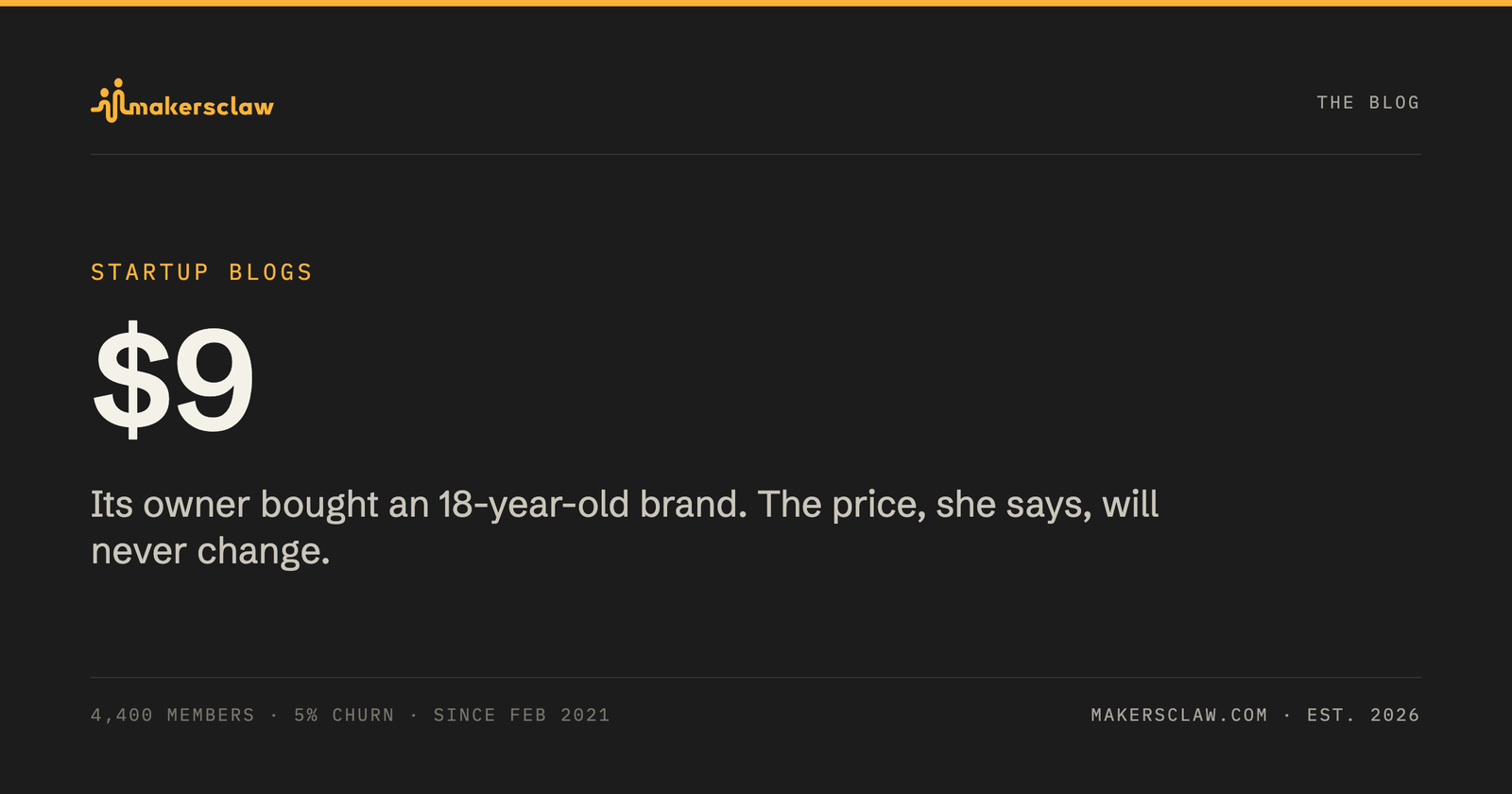
The owner of a $9 membership bought an 18-year-old brand. The price has never changed; she says it never will.
Liz Wilcox charges $9 a month for newsletter templates. About 4,400 people pay it, churn runs around 5%, and in April 2026 she bought Smart Passive Income. Her original target was 1,000 members in two years. The mechanism is a price nobody re-decides and customers who do the selling.
"There's 8 billion people on the planet. How easy would it be to sell 4,000 of them?"
Liz Wilcox says this in the first twenty seconds of a Creator Science episode published on 15 September 2026. She was answering the obvious objection: $9 a month is too little to build anything on. Her answer is arithmetic. Email Marketing Membership, her weekly newsletter-template subscription, has about 4,400 paying members. It brings in "about $40-something thousand" a month and has cost $9 since it launched in February 2021.
In April 2026, Wilcox bought Smart Passive Income, the creator-education brand Pat Flynn started in 2008. The seller told his side of the deal on the same podcast a week earlier. The buyer's side came with the number nobody expected.
The math she ran before she started
Wilcox says her target was a thousand members. Half a million dollars was nowhere in the plan.
"I was just looking for $1,000, y'all. 9 times $1,000 is $9,000 a month." She gave herself two years to get there. If two years of writing one newsletter template a week produced $9,000 a month, she says, "I feel like I'm robbing people."
She got the price from a positioning decision, not a spreadsheet. Everyone in the copywriting market sells sales emails because that is where the money is. Most people, she reasoned, need a newsletter, not a launch sequence. "I could be like the Walmart of email." She has kept the price at $9 through six years and about 4,400 members. Jay Clouse did the division live on the mic, and she confirmed it.
The retention figure deserves a closer look. Asked about churn, she says it is "about 5%." She calls it her "retention or churn rate," so treat it as a monthly figure, not an annual one. Her email list, she says, is more than half customers. There is no upsell, no mastermind and no coaching tier. She runs it with her sister.
The mechanism, which is two channels
She grew it without social media. She names exactly two acquisition channels.
The first is other people's audiences. She has been a guest on "almost 400 podcasts and virtual stages." That is where the warm leads come from.
The second is her own customers. "Who is selling a $9 product? You get almost nothing. My customers are selling the $9 product." Her offer is simple: refer two friends and the membership is free. She pays affiliates 50%, which is $4.50, and absorbs the processing fees. Her net on a referred member is "closer to $4."
Consider who the offer is for. Her ideal customer, in her words, is someone looking at $9 and thinking it might be all they can spend this month. For that person, a free membership is a real prize. A $4.50 commission is not. She rewards customers in their own currency. The same low price that makes the product easy to keep also makes it easy to give away.
The copyable version: price for the buyer who never has to re-decide, and pay the referral in the product, not in cash. That is the growth engine behind the business whose owner just bought an 18-year-old brand.
The seller spent eight years getting ready
Pat Flynn founded Smart Passive Income in 2008 and ran it for 18 years. Around 2018, Matt Gartland joined, first as an advisor and then as CEO. His brief was to make the company able to stand without Flynn at the centre.
Over roughly eight years, without knowing whether a sale would ever happen, they did four things. They spun the business into a separate entity, SPI Media. They took Pat's face off the website. They pivoted from courses to a community with recurring revenue and made the community the hero. They also kept preparing for a buyer they were not sure existed.
When the deal came, it had no broker. It used seller financing. It went through 160 documents of due diligence and closed in six months, in a category where these deals routinely fall apart. Flynn says he turned down VC and private-equity offers worth more than the final price. The price itself has never been disclosed, and nothing in either episode changes that.
The five quiet months
The deal closed in April 2026. It was announced in September.
During those months, Wilcox worked inside SPI as its "director of community." Nobody outside the deal knew she owned it. The community doubled in size in that window, according to Flynn and Gartland's account. When the announcement came, the new owner had five months of standing with the members she was about to be introduced to.
Most acquisitions reverse that order. They announce the deal, then send the new owner in to earn trust from a cold start.
What needed to be true
Clouse asked her what had to be true before she would pull the trigger on an 18-year-old brand with someone else's face on it.
"The only thing that needed to be true was that Pat believed I was the right person for the job."
Her stated motive was speed: "I wanted to accelerate my progress." In her telling, she came from almost nothing. She was a single parent building her first two businesses from library parking lots, Lowe's parking lots and laundromats, without internet on her phone. She lived in an RV. Today, she says, the business supports three households.
Part of what she bought is a licence. Flynn's book Superfans and the Superfan System built on it are, she says, hers to use and teach "for basically all time and eternity" under the agreement. The rest of the terms are not on the record.
The question she has not answered
Near the end of the episode, Wilcox says plainly that she does not know how a $9 membership and the SPI community fit together.
"I'm not sure how they live together. I'm really not."
Clouse asks whether she would raise EMM's price or lower SPI's. "I will never raise the price of EMM. If I could tomorrow, I would turn SPI Community into a $9 membership." She cannot, she says, because "I have to pay Pat." She knows the next step: announce herself as the owner and grow SPI's membership. The merger question goes in the diary every night. She says you might hear her in two years still running two memberships.
Two businesses, one owner, opposite price architectures. One was built on a price so low that the customer never thinks about it. The other was sold on recurring community revenue at a price that has to service a seller-financed deal. The method that got her here does not obviously transfer to the thing she just bought. She is the first to say so.
What to take from it
The $9 is not a discount. It is a segment decision, made once and never revisited. The referral loop works because the reward is priced in that segment's currency. The podcast circuit borrows attention she never had to build herself. Together, those choices produced a business durable enough for its owner to buy an 18-year-old brand. Each is available to a founder with no audience and no budget.
They still leave the next question unanswered. If you own two things with different price logic, which one bends?